
Glen Swyers, director of marketing integration at Imagine Group, didn’t actually get his start in the print industry at all. On the contrary, he spent many years as a certified trainer with the Walt Disney Company, and now he brings that mentality of how to approach learning and team education to the printing industry.
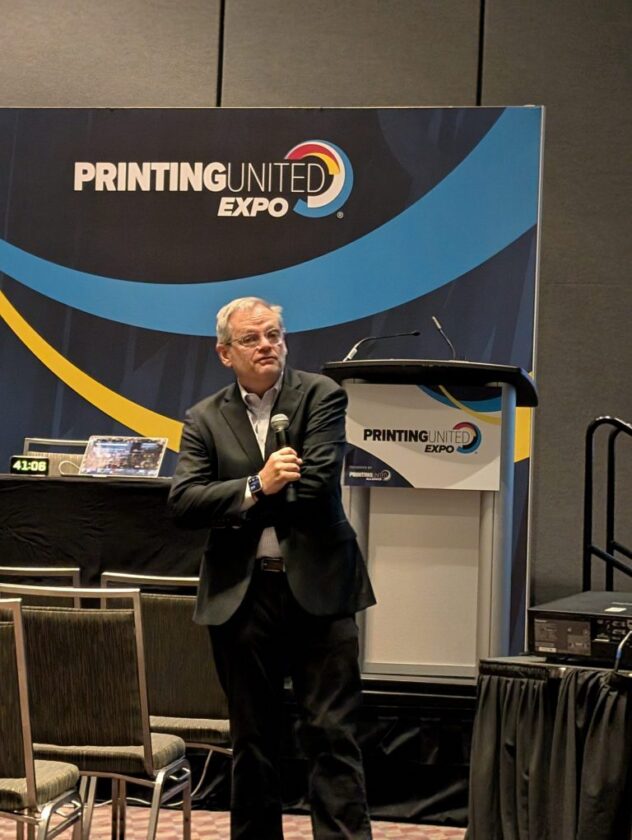
He detailed the four-step process that all Disney trainers use to quickly get new hires up to speed:
Step 1: Trainer Says, Trainer Does.
Initially, he notes, do the activity while also describing it. Go through it a few times, so both those who learn audibly can hear the instructions a few times, and those who learn by watching can see how it comes together at the same time. It’s a great way to engage both types of learners and ensure everyone can get the information in the way that works for them.
Step 2: Trainee Says, Trainer Does.
Next, have the trainees describe the process and walk the trainer through the steps, with the trainer still actually doing the actions, and being able to offer on-the-spot corrections, or ask questions such as “are you sure” to help reinforce the steps.
Step 3: Trainee Says, Trainee Does.
The next step is to have the trainees actually give the process a try themselves. Have them describe what they’re doing as they do it, and again, the trainer can be there to gently guide, answer questions, and help them commit the actions to memory correctly. This engages those who learn best by actually doing something.
Step 4: Trainee Does It.
Finally, the trainer steps back and offers no feedback as the trainees go through the process themselves. At the end of the task feedback can be given, but hopefully by this point it is just demonstrating that they understand the steps and can repeat them reliably every time without further instruction.
“Even ourselves, as individuals, when we receive just a little bit of information in a way that’s understandable, our IQ didn’t change, but our output definitely changed,” Swyers notes. He stressed that following a process like this engages every type of learner, and means that someone who learns best one way isn’t going to be frustrated and fall behind — or worse, walk away from the company and the industry because they think it’s not for them.
He also stressed that it’s not just about presenting the information in a way that each type of learner can connect with, it’s also about ensuring people understand why they are learning the information to begin with. Without that component, even the best training system will never work.
Swyers notes, “So basic learning concepts for adults, believe it or not, us adults, we learn differently than kids. One of the things that we learn better on is when it’s relevant to our needs. Probably a bad example now, but I’m old enough to remember when we would get an entire Owner’s Manual with our car, and it would be in the glove box. Have you ever read the entire Owner’s Manual? Have you ever had to change a tire and you’re trying to figure out where the heck you put this thing in? So you go to that page. That’s an example of us as adults — we learn the things that are relevant to us. When it’s relevant, I want to learn it. Part of my challenge to you is, when you’re teaching and training individuals at your organization, you’ll have to explain why it’s important for them to learn this, because if it’s not relevant to them, they don’t want to do it right.”
For printers looking to train new press operators on equipment, new prepress specialists on workflow, or anyone in the company on automation initiatives, this is good advice. First establish why the new information is relevant and important to each person and their job specifically, and then train them in such a way that all three sensory learning types are engaged — those who learn hearing something, those who learn seeing something, and those who learn doing something.
Finally, he said that training isn’t necessarily and one-and-done endeavor. Instead, after the primary training is done, reinforce and give feedback as needed to really help the new process or equipment become second nature. And feedback should be immediate — just like with dogs, he joked, you don’t try to discipline or reward them for something that happened two weeks ago. People are much the same.
“In 24 hours you really want to be giving them that feedback,” Swyers stresses. “And I really, really, really, really, mean this. This is something I really try hard to do, and it doesn’t matter if it’s physical, in a room like this, or nowadays, if it’s in a team group chat, or if it’s an email blast, etc. — do all your praise in public, but do all your critique in private.”
If someone does something right, gets it on the first try, is really nailing the new procedures, has that new press up and purring beautifully, make sure to give that feedback out in the open. Let everyone hear and see that you recognize and reward when things go right. But at the same time, if someone missies a step, or is struggling with something, pull them aside and give that feedback privately. And make it specific — I noticed you’re having trouble with this sequence of steps, lets walk through it a few more times together, for example. Or you keep forgetting to ensure files are properly organized and pushed into this new workflow, and I don’t want it to impact your productivity. Obviously every situation will be different, but don’t just tear someone down — make your feedback constructive, along with suggestions on exactly what they can to do to help improve and why taking those steps is relevant to them.
The entire presentation that Swyers gave at the 2025 PRINTING United Expo, was full of even more great tips and information to help attendees become better, more effective, and more empathetic trainers. Make sure to mark your calendar now for PRINTING United Expo 2026 in Las Vegas, Sept. 23-25, to hear more great speakers and educational sessions like this.