
That old cliché about the only constant being change rang truer than ever in 2025. And as the print industry (and virtually every other business sector, for that matter) learned over the last 12 months, a lot can seemingly shift by the hour. Tariffs, inflation and changes in international relations have created an environment of uncertainty where every business owner must consistently stay on their toes.
Uncertain, however, doesn’t mean impossible, or that doing business in 2026 is futile. Far from it, in fact. It’s just that it requires business owners to be more nimble, proactive and strategic.
That’s where our exclusive State of the Print Industry study comes in. Using ASI Research data along with perspective from within the print and promotional products industries, we show that, for every hurdle and difficulty, there are opportunities for growth and success.
“Over the past few years that we’ve been conducting research with print-first companies, we’ve seen the importance of being a one-stop shop for your customers,” says Nate Kucsma, senior executive director of research for ASI. “This year is no different. Our research helps provide guidance to the readers of PPM to show not only what other printing companies are selling, but also where they should focus their efforts.”
As print and promotional products continue to converge, print-first companies are being pushed to evolve – adapting their sales strategies, expanding their offerings and navigating a more complex set of business considerations than in years past. These shifts come on top of the broader challenges affecting the entire print and promo landscape.
The data and insights that follow break down where print and promo companies are finding success, where they’re facing pressure and how they’re adjusting to stay competitive in a rapidly evolving market.
Legislation Whac-A-Mole
Given all that happened in 2025 and early this year, it feels natural to start with the legislative side of things. It’s the elephant in the room. For instance, on Feb. 20, the Supreme Court struck down the country-by-country reciprocal tariffs as well as the trafficked tariffs placed on China, Canada and Mexico. President Trump responded by implementing a global tariff rate of 10% that would remain in effect for at least 150 days. The tariff policies of 2025 didn’t come as a surprise, but their fast-changing nature made it difficult for businesses to know exactly how to approach necessary processes like sourcing and pricing.
Andy Paparozzi, chief economist for PRINTING United Alliance, ASI’s strategic partner, says he’s focused on two main economic variables leading into the rest of 2026.
“Uncertainty created by erratic, no-one-knows-what’s-next tariff policies is the first,” Paparozzi says. “Put aside whether or not you agree with the objectives of the policies and focus on how they have been executed. If it’s clear that the tariff on a product is going to increase to X%, then you adjust to X%. But it’s very difficult to adjust to policies that border on the random.”
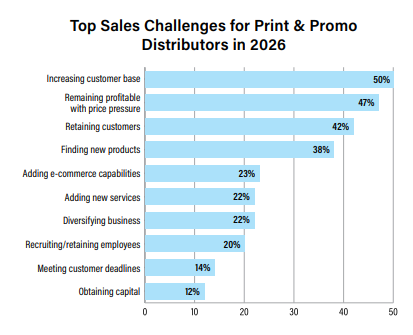
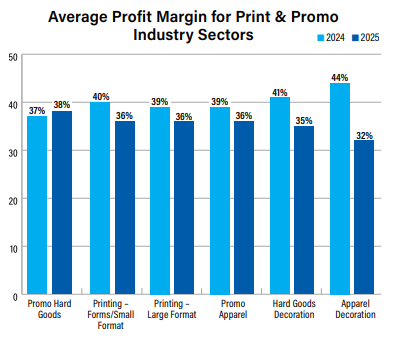
Not surprisingly, the State of the Print Industry report found that profitability will remain a top sales challenge in 2026 – second only to companies increasing their customer base. As goods cost more (ASI Research had previously found that nearly 90% of promo distributors increased their prices 11%-20% last year due to tariffs and price raises by suppliers), margins suffered across most print and promo categories (see p.26).
That’s the bucket of relatively cold water. Now comes the solution. “But if the issue is clients spending ‘differently,’ consider quantifying the value you create for clients,” Paparozzi says. “Show how much money you’ve saved them, how much time, how much you’ve increased the return to their promotional campaign, etc. Attach a monetary value to your contribution.”
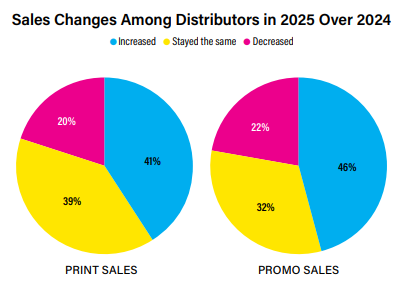
Even with the price squeezes and difficulties, print and promo distributors reported overall sales success. ASI Research found that 41% of respondents who sold print increased their sales in 2025 over 2024.
The key to some of that growth could be adding new products or services, or simply honing in on providing more than products and selling based on price alone. “I can sum this up in one word: value,” says Dean Manzetti, vice president for Canton Data Print. “Value sometimes is perceived as ‘cheap’ by some people. Value is what someone is willing to pay for a product or service that they’re happy with and fits their needs. We all run into pricing pressure at one point or another, but if you have that relationship with both your suppliers and customers, you can figure out those instances and still make a decent profit.”
The AI Age
The other factor Paparozzi is watching is the rapid rise of artificial intelligence. It seems like just yesterday that the best an AI image generator could do was produce a garbled, vaguely human image with melted wax-like facial features, or a recipe that instructed you to do things like “separate the egg from the egg and pour it into the lemon.”
Technology moves fast, and what was once something on the horizon is now a vital component of a business. “AI is automating time-sucking tasks we could never automate before, freeing employees to focus on activities that require and enhance their skills and that create value for clients,” Paparozzi says. “Everyone wins. Think of it as replacing tasks with value-added activities. Companies that master the trade-off will build a formidable competitive advantage.”
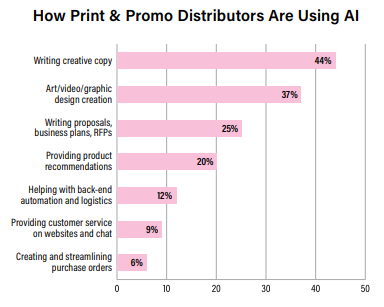
Despite all the hype surrounding AI, the State of the Print Industry report shows that 38% of print and promo firms still don’t use AI tools in their business – meaning late adopters can still achieve significant gains.
Stressing Value
Using AI isn’t the only way for distributors to make their print and promo businesses more profitable in 2026 and beyond.
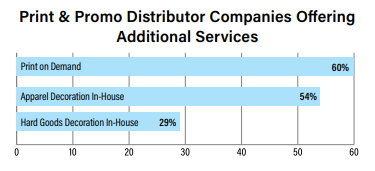
Rather than thinking about growing through subtraction – minimizing the time it takes for certain tasks through AI – companies can instead consider addition. And while AI is often the topic of conversation at industry events, another innovation designed for ease of use and mass appeal has emerged: print on demand.
The print-on-demand revolution, as it were, is here. With continued development of print and decoration techniques, like direct-to-film printing where decorators can print transfers and decorate pieces based on the demand rather than end up with dead stock, print on demand and related fields such as e-commerce are viable routes for decorators and distributors.
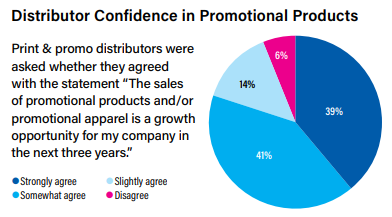
In addition, 80% of distributors see promo as a growth opportunity, with 4 in 10 distributors strongly agreeing with that sentiment.
Manzetti believes that even with continued sourcing difficulty and pricing issues, customers are still gravitating toward physical products.
“It seems like compared to post-COVID until now, customers are more open to spending on these items than they were back then,” Manzetti says. “We see them doing more trade shows, company functions, employee giveaways and various other promotions that they hadn’t been doing three or four years ago. Budgets have opened up and they’re spending more on promo and apparel, so now and the next couple of years is the time that we see tremendous growth opportunities in these areas.”
ASB (asi/120075), a Counselor Top 40 distributor and Print & Promo Marketing top print distributor, has put a lot of emphasis on diversifying its print offering to meet current demand. Much of that came from shifts in end-user habits during the pandemic – yet another case of finding a long-term positive solution in a difficult situation.
“ASB has experienced strong diversification across print categories,” says Amy Spychalla, vice president of strategic operations support for ASB. “Packaging has been the most transformative category we’ve seen within ASB and as an industry in the last several years, thanks to the pandemic. Not only have we experienced growth in the category, but it’s helped build a bridge between traditional print and promo business, positioning us as a true brand partner to support merchandising and brand awareness in a broader scope.”
Spychalla is talking about the rise of kitting. Kitting was around pre-pandemic, obviously, but when businesses shut down and people were stuck in their homes, brands needed to find ways to meet their end-users without the availability of large giveaways in person or trade shows. The branded kit was the answer. Companies could take a variety of items like apparel, drinkware, electronics, outdoor products and even food, and put them all together united by a theme and packaged in a branded box.
Once pandemic restrictions lifted, distributors didn’t abandon the kitting idea. Instead, they realized that it was a handy way to include a variety of products with the “unboxing” experience appreciated by younger generations who grew up online, with packaging as the first impression.
With that, the appeal of becoming a “one-stop shop” for customers grew, as they could source products across different categories from one, or at least fewer, vendors and therefore deal with fewer costs and variables.
For printers and print distributors whose customers are buying promo already, this means adding new product categories and capabilities like decoration.
“Print distributors can keep looking for opportunities for cross-selling and upselling based on marketing strategy,” Spychalla says. “Be an extension of the customer’s marketing team, not just an order taker.”
End-buyers take note of that kind of thing, and will want to work with distributors and print vendors who provide them with a positive experience, leading to repeat orders.
“To stay competitive, distributors often expand into high-demand categories like apparel and hard goods,” says Tom D’Agostino, president and CEO of Smart Source (asi/328914), another of Print & Promo Marketing’s top print distributors and a Counselor Top 40 distributor. “These items offer a broader solution set for clients. And with integrated branding across print and promotional items, it strengthens customer loyalty and boosts margins.”
Adds Spychalla: “If you already have a customer’s trust and a relationship established, why stop at just print?”
Finding Opportunities
In 2026, flexibility and a variety of products across print and promo could become even more important due to the midterm elections. This also applies to promotional products distributors who might be curious about adding print products to their business.
“In general, election years boost print sales due to the surge in campaign materials – yard signs, brochures, mailers and promotional items,” D’Agostino says. “The heightened demand is driven by local, state and national campaigns for visibility, creating a spike in print orders. If in-house resources are stretched or limited, outsourcing can increase.”
This means that in addition to selling one’s own products, companies with in-house decoration or print capabilities could be contracted by others hit by high demand for election-related materials.
Elections happen on a regular basis, not just every two or four years. Printers and distributors can look from the smallest local elections to national elections to find opportunities for print sales, as well as promo sales, and scale their efforts according to the demand. Smaller elections mean smaller output of products and print collateral like direct mail or ballots, while national elections feature much larger operations and potential for profit.
On the topic of elections, the actual results of the elections this year could impact the way that printers and distributors continue to operate. At the very least, it could impact perceptions of the economy and influence the next steps they take.
“The midterms are another layer of uncertainty, and over the past year we’ve experienced the difficulties extraordinary uncertainty – whether economic, political or technological – can create,” Paparozzi says. “During periods of extreme uncertainty, the tendency is to sit tight and wait for clarity. The opportunity, however, is to create clarity by moving ahead with business plans and priorities; capital investments that support productivity, automation and production speed; investments in workforce development, promotional plans, the exploration of AI, etc.”
Paparozzi adds that while it’s understandable for a business owner to feel frozen or intimidated by uncertainty, he warns of the perils of inaction.
“Put another way,” he says, “always consider the cost of not investing – i.e., the risk of falling behind.”
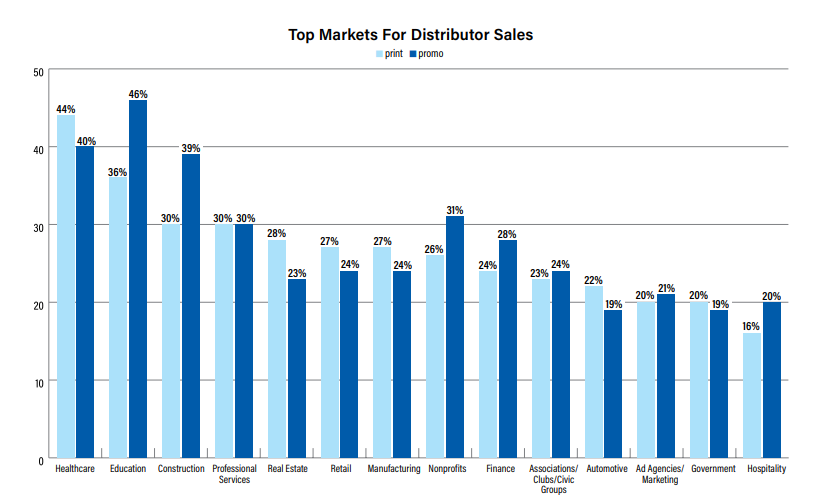
Outside of elections, there are a number of sales verticals that print distributors and promo distributors rely on.
Within print, ASI research found that the most common sales vertical for distributors is healthcare, with 44% of print distributor respondents citing it as their top customer market. This is unsurprising, given the abundance of paper forms and related products. Healthcare ranked second for promo distributors, with 40%.
Manzetti says that high schools and universities, particularly Catholic high schools, have been one of the most reliable areas for selling print. The difference, he points out, is that religious schools or other private schools require things like fundraising initiatives that, in turn, require advertising not unlike an election.
“We do a lot of printing for fundraising and lots of direct mail campaigns that they use for recruiting purposes,” he says. “Typically, these are nice high-volume mailings either with multiple pieces – envelopes and inserts – or a simple postcard. These direct mail campaigns could be anywhere from 8,000- to 50,000-piece mailings. The bigger schools will do these mailings two to three times a year.”
Spychalla also notes that, even though some categories have turned forms and processes that were once on paper digital, she’s noticed that paper still has its place, and that it may be reclaiming some of its former prominence.
“While there are many industries that have moved a lot of their operational and business print to digital platforms – automotive, financial, healthcare – we’ve seen a rebound in all of those industries when it comes to commercial print,” she says. “Being able to share information with consumers in a tangible way is still vital to earning and retaining customers and clientele.”
Looking at a Greener Future
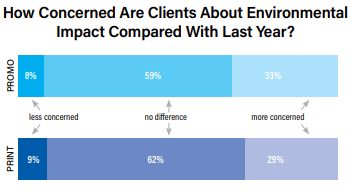
As younger generations age into more decision-making positions, progress in areas such as environmental awareness and stewardship will continue. In the U.S. alone, we’ve seen legislation enacted that would affect the print and decorated merchandise industries, such as limiting PFAS chemicals, extended producer responsibility legislation for packaging and a push for more sustainable materials used in products. As a result, there continues to be a heightened awareness among clients about sustainability.
Action & Adaptation
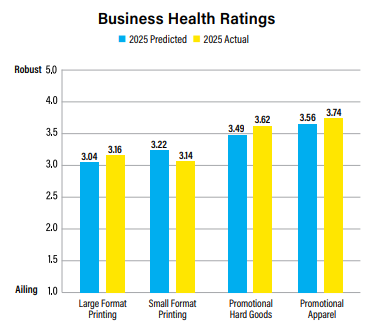
Interestingly, when asked about the health of the mediums they work with, distributor ratings for 2025 exceeded predicted forecasts.
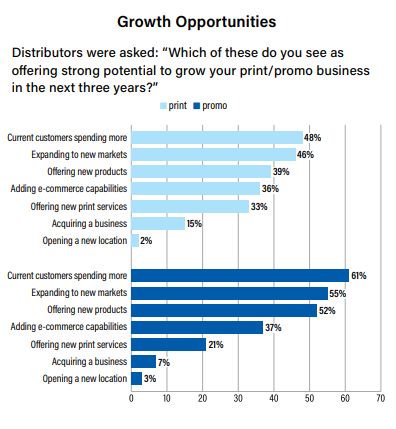
And there are still plenty of places for encouragement and opportunity in 2026. For distributors selling either print or promo (or both), current customer spending, expanding to new markets and offering new products represent strategies with strong potential to grow their business.
Paparozzi warns, though, that these don’t magically translate to a more impressive bottom line. Opportunity requires action, and while a rising tide once lifted all boats in the industry, added economic pressures have made it imperative to keep up.
The cyclical changes – the ups and downs, the natural ebbs and flows of the economy – require adjustment, not redefinition. Paradigm shifts in the industry itself and the way companies do business, on the other hand, require more substantial transformations.
These are things like the continued adoption of print on demand going hand in hand with e-commerce and online shopping, as well as the speed-of-light evolution of AI and AI capabilities.
“Structural change doesn’t simply create new ways to do what we’ve always done,” he says. “It creates a spectrum of new possibilities that require new mindsets and approaches, and it exempts no one. You either adapt or get left behind.”
The prevalence of AI does nothing for your business if you don’t start using it. Understanding that print on demand is a trend means nothing if you’re not the one capitalizing on it. This applies to looking at emerging and growing markets, opportunities for greater environmental focus and expanding into other areas of profit generation like promo and decoration.
“The question every printing company owner should ask is ‘What will we do better in 2026 than we did in 2025?’” Paparozzi says. “Because during periods of structural change, we’re either getting better or falling behind. There is no third option.”