
Key Takeaways
• Topps replacing Panini as FIFA’s official trading card and sticker partner in 2031 marks the end of a 60-year era that has shaped a massive global collecting culture around World Cup stickers.
• Panini’s sticker books have become a powerful fan engagement phenomenon, inspiring large-scale trading events and community gatherings that demonstrate how simple collectibles create lasting emotional connections.
• Fanatics and Topps plan to modernize FIFA collectibles with innovations like game-worn memorabilia cards, while still relying on the accessibility and social appeal that have made stickers a successful promotional tool.
For those who aren’t religious about the FIFA World Cup every four years, the news that Topps will become the official producer of soccer cards and stickers for the World Cup and other FIFA events beginning in 2031 might not seem all that big.
But, if you understand the scale and the fandom associated with Panini stickers, it becomes clear that this is a subculture-altering moment.
Panini has been the licensee for FIFA World Cup trading cards and the official sticker books since 1970, having supplied official sticker books for every tournament aside from the 1994 World Cup, when Upper Deck secured a one-time licensing deal for the tournament.
Panini stickers started in the 1960s, when Italian brothers Benito and Giuseppe Panini launched the Calciatori soccer sticker collection in Modena, according to Sports Collectors Daily. The Panini brothers saw the appeal of self-adhesive stickers over things like stamp collections, which were glued in place by collectors. They wanted to create something that felt like part of a larger more exciting collection, and accessible to fans of all ages. Plus, it incentivized trading, which is still a common practice today.
Take, for example, the fact that thousands of fans attended a sticker swapping event on the pitch at Bicentenario Stadium in Santiago, Chile.
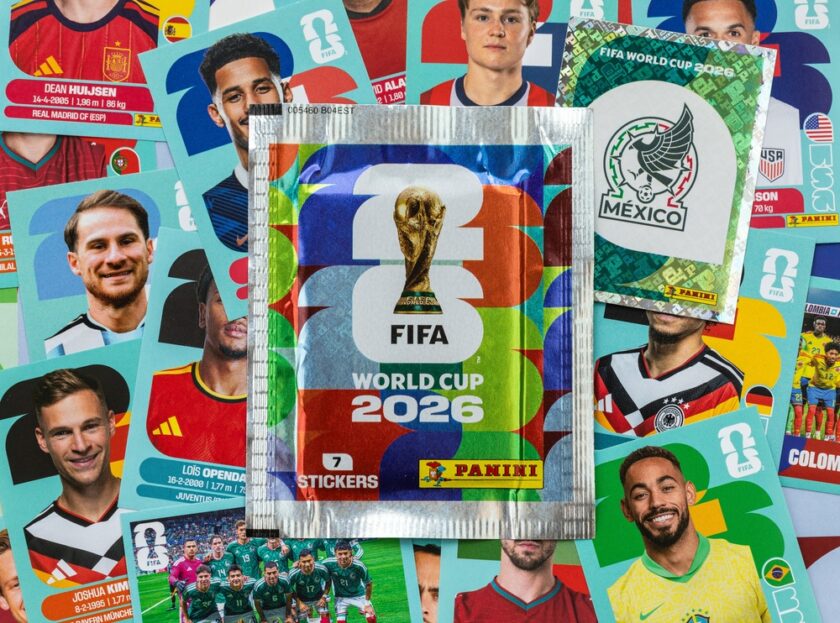
With the expanded 48-nation World Cup in 2026, this year’s Panini sticker book is the largest yet, and fans will be able to attend events in host cities like New York, where Rockefeller Center will play host to a special Panini truck where fans can buy stickers and cards, and interact with other collectors and fans. There will also be exclusive, limited-edition stickers available at the Top of the Rock observation deck.
“Our Panini FIFA World Cup sticker collection has brought fans all over the world together for generations, and this year’s FIFA World Cup sticker collection, our largest ever, is no different,” said Jason Howarth, senior vice president of marketing and athlete relations at Panini America. “For us, it makes perfect sense to have this presence in the heart of New York City, giving us an opportunity to engage and celebrate with soccer fans of all ages, nationalities and with soccer fans all over the world.”
The Fanatics Future
Let’s go back to the fact that, starting in 2031, Topps, which is owned by Fanatics, will become the official licensed sticker supplier for FIFA. Fanatics is at the forefront of the branded merchandise game – both physical, like T-shirts and collectibles, and intangible, like NFTs and other virtual products. To bet on print, as it did when it acquired Topps for half a billion dollars in 2022, means that Fanatics sees the value in this medium.
“With Fanatics, we see that they are driving massive innovation in sports collectibles that does provide fans with a new, meaningful way to engage with their favorite teams and with their favorite players,” FIFA President Gianni Infantino told The Athletic. “So, from FIFA’s point of view, we can globalize that fan engagement precisely thanks to our global tournament portfolio. And this provides another important commercial revenue stream that we channel back, as always, into the game, into football.”
Fanatics owner Michael Rubin, too, acknowledged that the global appeal of soccer through FIFA is a way to build the business. One thing Rubin and Fanatics plan to do is incorporate the match-worn patch program in place for other sports, where players wear commemorative patches that are then removed and placed in a trading card.
Infantino, also not one to avoid a money-making opportunity, said that this decision was in part inspired by the enthusiastic collector’s spirit in America.
“I’ve seen that for myself at Formula 1, at NFL, at UFC, at NBA – you name them – and now we can move into the football arena with Fanatics, who are the leaders in this particular space,” he told The Athletic. “So, this deal enhances fan engagement and storytelling by creating deeper emotional connections between fans and players via collectibles, or via, for example, game-used memorabilia and other events.”
The game-worn memorabilia is certainly exciting. But those sorts of limited-edition collectibles can be more expensive for the common consumer. If there’s one through line in soccer, it’s that it’s accessible to anyone with a ball.
The sticker, something relatively simple to manufacture, suddenly becomes much more valuable than the paper it’s printed on thanks to the emotional attachment. And it’s something everyone can use. That’s not just true for soccer, but for any promotional campaign where a logo or message or feeling can live on and decorate a new space – whether it’s a collector’s book, a helmet, a notebook or even a signpost.
By creating something that makes people interact with the product as well as other people, and then keep as a collector’s item, it becomes a very meaningful promotion and brand activation through something as simple as stickers in a booklet.