
Key Takeaways
• Print-on-demand workflows can reduce inventory risk and waste by allowing companies to produce only what’s needed, when it’s needed, according to PRINTING United Expo speaker Rusty Pepper.
• POD works best for short runs, localized campaigns and uncertain demand.
• Pepper says hybrid models can give clients greater speed and flexibility while letting successful campaigns transition to bulk production for better pricing.
The print and promo industries do a lot of things well, but there are also “a lot of things that are tired and that need to be retired,” according to Rusty Pepper, head of global markets and partnerships at Taylor OnDemand, part of Counselor Top 40 distributor Taylor Promo Marketing (asi/333647).
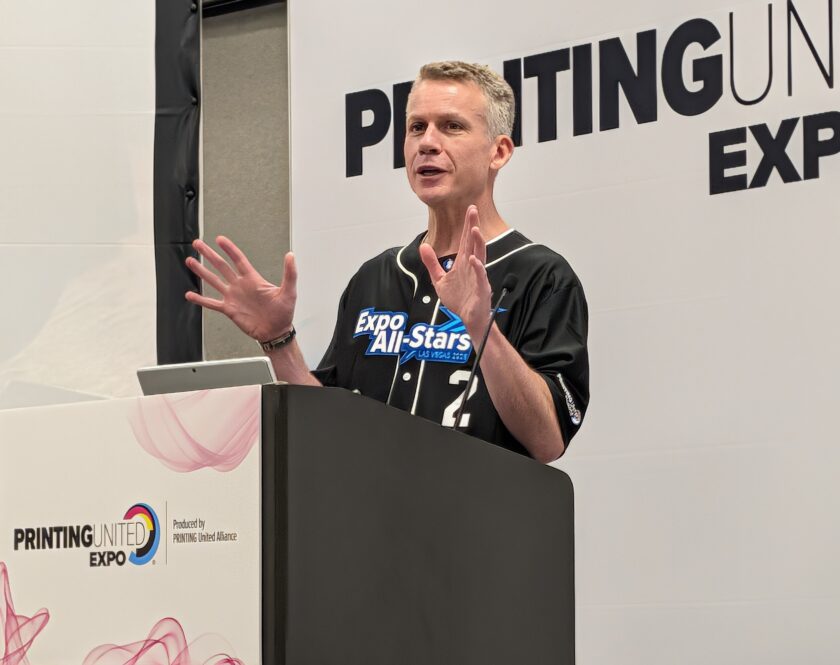
Pepper was on hand at PRINTING United Expo, held Sept. 23 to 25 at the Las Vegas Convention Center, to discuss the limitations of the traditional, analog fulfillment model and explain how print-on-demand (POD) workflows can meet customer expectations for speed and creative execution.
In an interactive session dubbed “How Tech + Creativity + On-Demand Fulfillment Are Reshaping the Marketing Supply Chain,” Pepper shared his definition of POD: “It’s about what doesn’t happen between art approval and production. There’s no messy middle.”
Traditionally, he added, clients would forecast spend, commit resources, write a purchase order and pay. Print and promo companies would produce in bulk, often storing items in centralized warehouses. Then, Pepper said, “Clients would cross their fingers and hope they guessed right – that the numbers they gave were accurate, that their campaigns lasted as long as they thought they would and that the brand wouldn’t change.”
Switching to a POD workflow can eliminate that guesswork, helping to alleviate waste. (By some estimates, as much as 40% of bulk inventory ends up wasted, he added.)
That’s not to say bulk ordering is obsolete. Pepper shared four scenarios during his session, asking attendees to guess which would be most suited to POD and which is better handled with traditional fulfillment methods. High-volume orders with stable branding and predictable demand are still ideal for bulk ordering. As is a custom product that requires special tooling and complex production. Bulk ordering helps to amortize out the high cost of the highly custom work.
On the other hand, Pepper pointed to a short print campaign of three weeks that requires 37 localized versions and speedy production. That, he said, is perfect for an on-demand workflow.
A fourth scenario (a national program with uncertain adoption) actually points to a hybrid approach. Printers can begin with a POD model to A/B test in real time. Then, if the campaign proves successful, production can move into bulk to get better pricing and stability, Pepper said.
It’s all about educating clients on what works best for them and how print and promo distributors can help them minimize risk, he added.
Customers rarely ask for POD by name, but in an Amazon-fueled world, it’s absolutely what they want. They’re looking for the speed, control, relevance, flexibility and visibility that POD enables, Pepper said.
If the print and promo industry is able to fully embrace POD workflows and meet the creative iteration and exploration it allows for, the future is bright.
“Moving into the digital era, there’s nothing but green space,” Pepper concluded. “In a world full of clicks and bytes, we’re the only thing that’s tangible. That’s a really, really powerful medium to be in.”