
Key Takeaways
• ASI’s 2026 Ad Impressions Study found that international consumers have an overwhelmingly positive view of promotional products, with 95% saying they would view an advertiser more favorably after receiving a promo item.
• In addition, 92% of consumers said they’d be more likely to do business with the company that gave them a promo item.
• The study also revealed that practical, high-quality products resonate most with international audiences, with T-shirts and mobile power banks ranking among the most desired promo items.
The promotional products industry becomes more global every year, whether that’s through increasing numbers of North American distributors and suppliers operating overseas offices or campaigns for major corporations unfolding on a global scale.
Accordingly, ASI Research expanded our 2026 Ad Impressions Study to include consumers in 21 European countries – including major markets like Germany and the United Kingdom, as well as smaller nations like Croatia and Portugal – and Mexico.
In many ways, the results are similar to ASI Research’s findings from the United States (released in March) and Canada (released in April) – namely, that promotional products around the world leave an overwhelmingly positive impression on consumers who receive them. But it’s also worth noting that many of the statistics gathered – including favorability, sustainability and likelihood to do business – are noticeably higher for international markets compared to the U.S. and Canada.
Be sure to read and download the full report here. In addition, here are three key takeaways from the international segment of this year’s study.
1. T-shirts and tech are the most sought-after promo items.
We asked consumers in each surveyed country what promo products they would be most excited to receive, and – just as in the U.S. and Canadian studies – T-shirts topped the list. That’s good news for promo pros, since T-shirts, at least in the U.S., are the top product by share of industry sales, according to the latest Counselor State of the Industry data. Food gifts, bags and fleece (especially in colder locales like the U.K. and Scandinavia) were common answers, also in line with findings from the first two segments of the Ad Impressions Study.
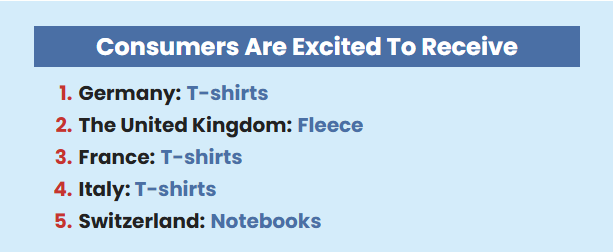
However, notably for the European market, mobile power banks were the second most popular, also appearing in the top five products for nearly all countries surveyed. Another tech category, USB drives, also made an appearance in several top five lists, as did notebooks, which ranked number five on the overall rankings.
Distributors should bear those trends in mind when pitching to clients beyond North America; for example, consider a tech or a stationery item over a drinkware piece. And it’s also worth noting the countries with more unique answers. Spain, for instance, was the only country to have “calendars” rank in the top five most preferred items, while “umbrellas” appeared in Switzerland’s top five. It’s an important reminder that while overall trends may be similar across the world, individual consumer groups have their own preferences.
2. Quality and usefulness are key considerations for most consumers.
When it comes to consumers purchasing merch themselves – say, in gift shops or at an event – the top factor that influences their purchasing is quality. And it isn’t close.
Two-thirds of international consumers (65%) report that the quality of an item would influence their willingness to buy a promotional item, well above the second most popular choice of design (38%). Though the top two considerations are the same, that’s a much more significant gap than reported in the U.S. study, where 55% of respondents said quality would influence their willingness to purchase compared to 50% for design.
There is some variation in what makes international consumers most likely to hang onto a promotional item. Consumers in Mexico, for example, value having an “attractive” product more than consumers in other countries, while in Croatia, consumers most value items that are “enjoyable to have.”
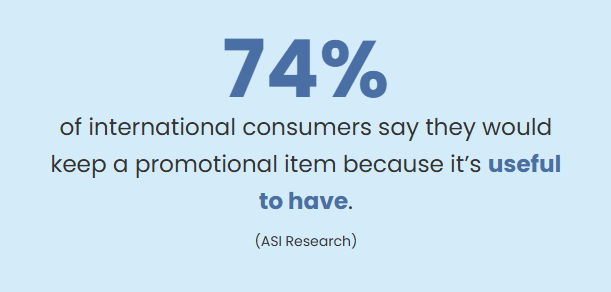
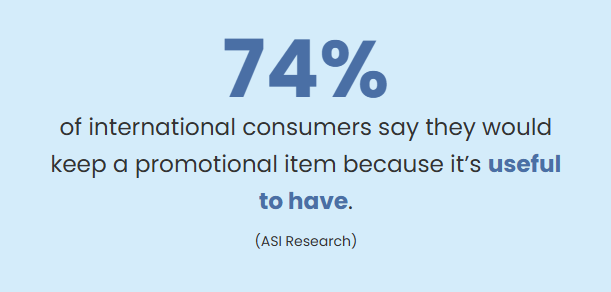
But “usefulness” was on top for every country surveyed, with as many as 91% of consumers stating that they’d keep a promo item because it’s useful to have. (That figure was reported in Finland, the highest percentage of all countries from the survey.) Combined with their stated preferences on quality and higher-end appearance, practical products with simpler branding might perform better in the European market.
3. Consumers around the world have an exceptionally favorable view of advertisers after receiving promotional items.
Across the thousands of international consumers surveyed, 95% reported that they would have a more favorable view of an advertiser after receiving a promotional item. Ninety-two percent said that they would be more likely to do business with said advertiser.
Those stats are a powerful testimonial to the positive impact promo has on recipients, especially when compared to other forms of advertising. And it’s worth noting, too, that both figures are even higher for the international market than the U.S. or Canada (which were already impressive in their own right).
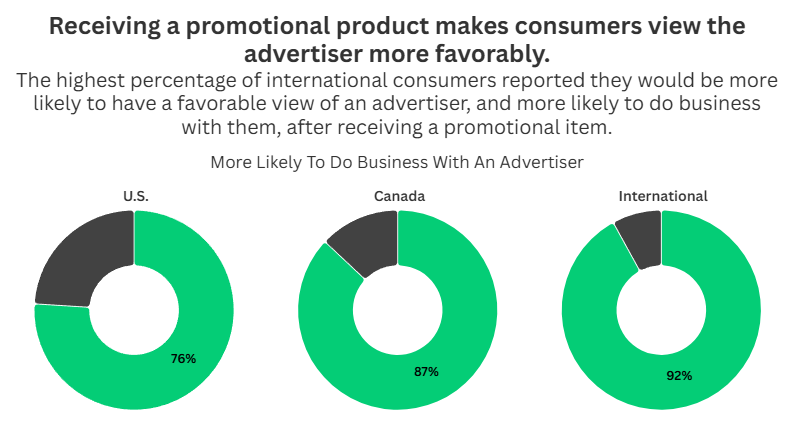
There’s likely no single explanation for the difference. The European promo market is smaller than the U.S., so consumers may receive promotional products less frequently. It may reflect a stronger emphasis overseas on custom, retail-inspired items that carry higher perceived value.
Sustainability also has a greater impact in Europe than in the U.S. Nine out of 10 consumers internationally would have an even more favorable view of an advertiser after receiving a sustainable promotional item, compared to three-quarters of U.S. consumers. That reflects Europe’s leading position on sustainability and how much it resonates in that marketplace.
For a variety of reasons, promotional products outperform TV, social media, radio and internet advertising among consumers in every country surveyed. The common thread is clear: Across the globe, consumers favor promotional products over every other form of advertising, regardless of demographic.