
Key Takeaways
• Printers are facing a profit squeeze as operating costs rise faster than many companies feel able to increase prices.
• Workforce pressures, postal policy and emerging extended producer responsibility requirements are adding uncertainty.
• Diversification remains a growth opportunity, with buyers looking for a one-stop shop experience.
The print industry is facing a challenging year, filled with economic uncertainty and price pressures. At the same time, however, there are opportunities available to those who diversify and embrace new technologies.
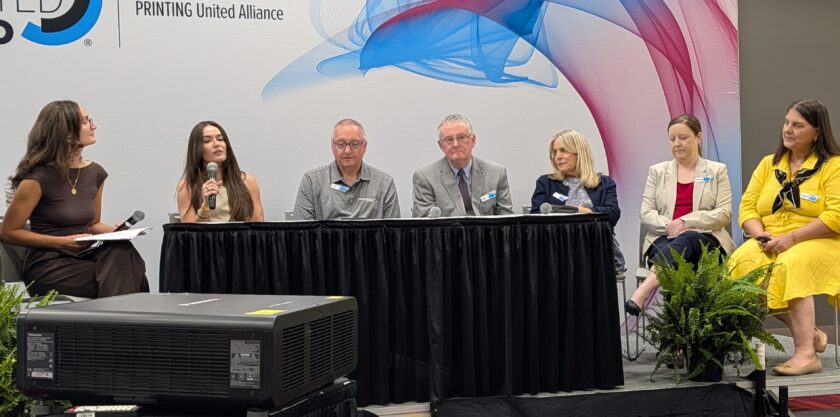
Those were just a few of the revelations from subject matter experts in the PRINTING United Alliance, who spoke at a “Trends, Truths & Takeaways” roundtable moderated by Printing Impressions Content Director Ashley Roberts during PRINTING United Expo, held from Sept. 23 to 25 at the Las Vegas Convention Center.
Andy Paparozzi, chief economist at Alliance Insights, noted that the industry is facing a “classic profit squeeze” brought on by inflation. In fact, around 84% of printers surveyed by the Alliance reported that their costs have increased this year because of inflation, but because the market is so shaky, only 55% of them have raised their own prices. And only 15% have raised prices high enough to cover increases in operating costs, according to Paparozzi. Another factor of the unstable economy: Half of those on the Alliance research panel say they’ve either canceled or delayed capital investments in 2026.
Economic uncertainty is also affecting employee hiring and retention, said Adriane Harrison, vice president of human relations consulting at the Alliance. She expects that by the end of the year, the print industry will see a wave of layoffs. But as companies are able to rehire workers, they may find themselves out of luck, with other industries drawing from the labor pool. She pointed to AI data centers, in particular, “paying a staggering amount of money” to the tradespeople building their facilities.
“We’re in a real pinch,” Harrison said. “Hold off on layoffs if you can. Find other ways to trim your margins.”
Alliance subject matter experts also gave an overview of a few other issues affecting print. Stephanie Buka, government affairs manager at the Alliance, talked through the current state of the U.S. Postal Service and how it affects the direct mail sector of the print industry. The Postal Regulatory Commission denied a USPS waiver request to increase rates in January, a positive development for the industry, Buka said. The postmaster general has also approached Congress, asking for more funding to remain operational.
“Our position is don’t write a blank check to the Postal Service,” Buka said. “Put some guardrails on that. Make sure service standards and performance are up to par.”
Sara Osorio, manager for environmental, health and safety and sustainability at the Alliance, updated attendees on the latest regulations regarding extended producer responsibility legislation. The intent behind EPR laws is to put the onus on businesses that create packaging and other materials to pay for end-of-life disposal or recycling. Several states have passed EPR legislation for packaging, and California has an EPR law for textile waste as well. There are several lawsuits pending against EPR legislation in different states, though a lawsuit filed by the National Association of Wholesaler-Distributors was unsuccessful in overturning Oregon’s packaging EPR law, Osorio said.
“The future of EPR does remain to be seen,” she added.
Gary Jones, vice president of EHS affairs at the Alliance, discussed the disaster preparedness plan the Alliance is putting together to help businesses figure out how to handle various emergency situations, from floods to fires. It’s a resource the Alliance will provide free to its membership once it’s completed, and if implemented properly, printers will not only have a plan in place to deal with disasters, but could potentially also see a reduction in insurance rates.
Lisa Cross, principal analyst at Alliance Insights, shared data collected on today’s print buyers, noting a generational shift in who’s buying print: 60% of buyers are millennials now. They’re looking for companies that can offer one-stop shop solutions, combining print, promo, mail, apparel and fulfillment – anything that can make their lives easier, according to Cross.
The good news about these buyers? “They like print,” she said. “What we see with a lot of buyers is that the digital fatigue has set in. Customers have tuned out to digital.”