
Key takeaways:
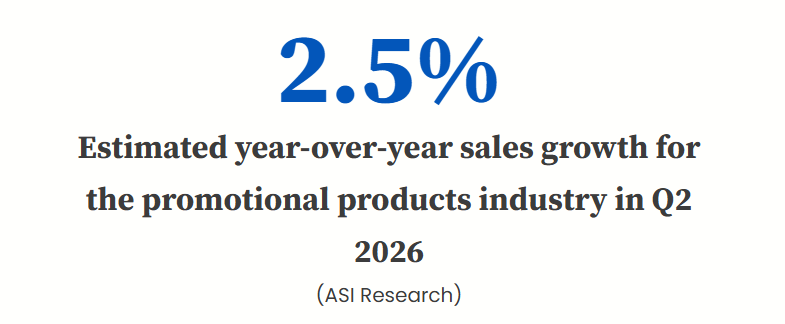
• Promo industry sales gained momentum in Q2, rising 2.5% year over year, an improvement from Q1.
• Growth remained uneven across the industry. Larger distributors outperformed smaller firms, while suppliers generally reported stronger results than distributors.
• The Counselor Confidence Index ticked up slightly, signaling cautious optimism for the second half of 2026 even as tighter budgets, geopolitical uncertainty and higher costs cause headwinds to persist.
The promotional products industry picked up speed in the second quarter, but significant roadblocks remain.
The latest ASI Quarterly Sales Survey found that industry sales grew 2.5% year over year in the second quarter. While that fell short of the sales acceleration recorded in the second half of 2025, it marked an improvement from the 1.8% increase reported in the first quarter.
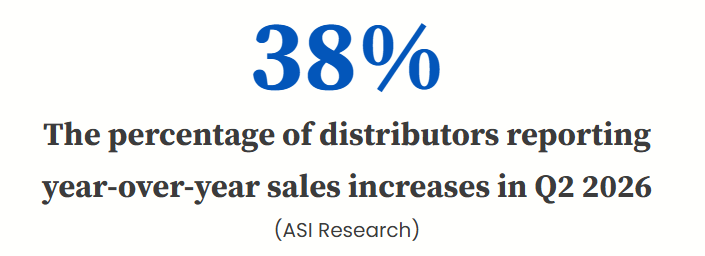
The quarter was a mixed bag for distributors, with nearly identical percentages of companies reporting year-over-year sales increases and decreases (38% and 37%, respectively). Those figures also mirror distributor reports from the previous quarter.
“While not quite a full exhale, it seems like in Q2 the industry was starting to shake off what seemed like a constant barrage of challenges and uncertainty it experienced much of last year and this year,” says Nate Kucsma, ASI’s senior executive director of research, who spearheads the ASI Research Quarterly Sales Study. “The hope is that the industry is primed for a strong second half.”
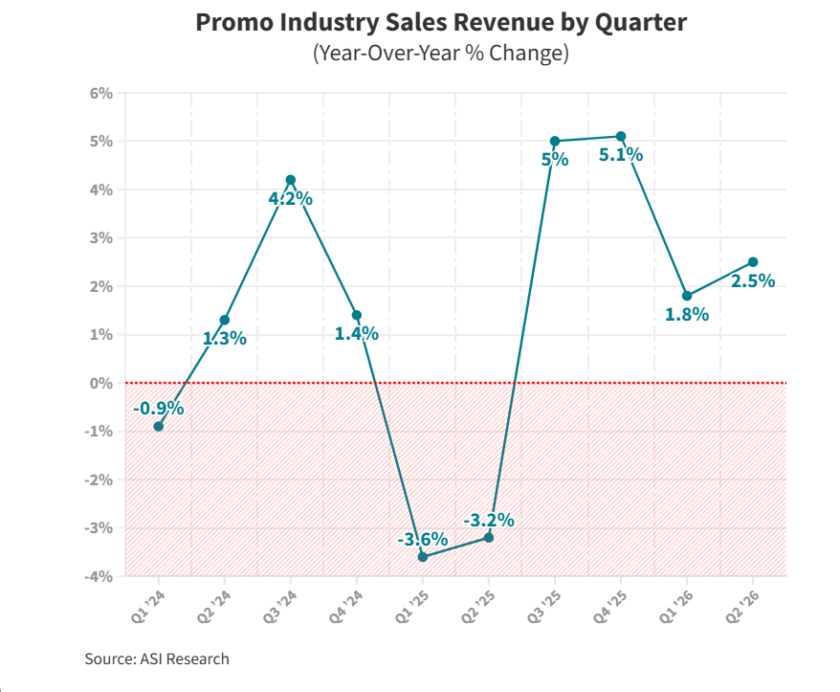
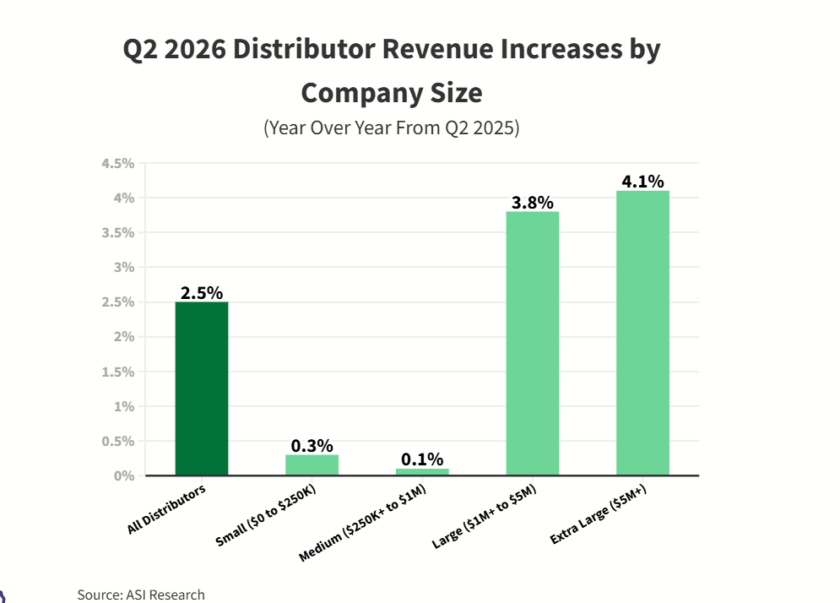
Notably, larger distributors significantly outperformed smaller distributors. Small and medium-size firms, or those with annual sales below $1 million, were essentially flat on the quarter. Comparatively, large and extra-large firms, or those with annual sales above $1 million, reported growth closer to 4% compared to the same period last year.
There were plenty of challenges in the quarter. Inflation climbed to a two-year high of 4.2% in May, driven by a sharp spike in energy and gasoline prices stemming from the conflict in Iran. (Core inflation, which excludes food and energy, peaked at 2.9% this year.) Shipping container rates reached a three-year high, and the lingering war in Iran continues to weigh on marketing budgets and consumer spending.
The supplier side was slightly rosier, with 42% of firms reporting higher year-over-year sales in Q2 compared with 31% reporting declines. Despite outperforming distributors by this measure, suppliers had high expectations for the quarter that weren’t as easily matched. More than 4 in 10 suppliers reported that sales were worse than anticipated in Q2, with just over 2 in 10 stating that sales were better than expected.
Signs of Success
For distributors who work with government-affiliated, nonprofit or education clients, Q2 is often unique because it marks the end of the fiscal year for these companies and organizations. Instead of the holiday season, marketing budgets roll over at the start of summer – which means that May and June can be the onset of a “use it or lose it” attitude, says Colin Lester, president at Washington, D.C.-based William Kendrick Company (asi/241100).
Lester reports a particularly strong April and May for sales because his clients in the associations, clubs and civic groups vertical were calling and ready to spend before the end of the fiscal year.
Cassidy Parsons of Awards4U (asi/341537) notes a similar phenomenon with one of his main clients, a large state government department. He’s seen notable sales increases so far in 2026 for challenge coins, lapel pins and apparel, along with consistent sales in the drinkware category, as the client has signed off en masse on a huge variety of product pitches Parsons has sent over the past few months, sometimes without even seeing artwork.
“When it gets to quarter two, usually the state organizations say, ‘We have this budget – we have to spend it or we’re going to lose it,’” Parsons says. “They just want to spend the money and get it done.”
He’s expecting his generally stable first half to continue for the rest of the year, but that’s largely attributable to Florida State University’s recent acquisition of the large local hospital system in Tallahassee, FL, which Awards4U is managing the marketing and branding for. That means items like signage, displays, tents and the like to help spread awareness in the community.
In that sense, Parsons’ experience is an indicator of success when promo is viewed as a necessity for corporate budgets, rather than a “nice to have.” In his case, new displays and signage for the hospital system’s shift are essential for the hospital’s transition.
Uniform programs are another example of stability, says David Lever, senior vice president at supplier Propper (asi/80114), which focuses on specialized uniforms for police, firefighters and similar industries. Propper manages significant business for the U.S. government, Lever says, and business is up this year after a solid second quarter.
Similarly, David Addi, the owner of Fired Up Promos (asi/439061) in Baltimore also was up on the quarter, thanks to a particularly busy June. But he attributes much of his stability this year, again, to a uniform program run through the distributor’s largest healthcare client. “They seem to always be growing,” he says.
In addition, fast-growing industries like artificial intelligence are proving to be a key opportunity for some promo firms. Counselor Top 40 distributor Nadel (asi/279600) told Counselor that the Los Angeles, CA-headquartered company was up nearly 20% year over year in Q2 thanks to big business from AI and tech firms in Silicon Valley, and a particularly strong June.
“I’m sure this is the rule and not the exception, but we tend to get orders from the segments of the economy that are doing well,” said President and CEO Craig Nadel, a member of Counselor’s Power 50 list of the most influential people in promo. “Right now AI is getting a lot of love from investors, and AI companies have a lot of money to spend, so we are getting a lot of business from AI companies. I don’t think it is anything special about AI – it is just that those are the companies with a lot to spend these days.”
And demand still exists for creative, quality merch. Saranoni (asi/97087), a retail luxury blanket brand that entered the promo space just last year, has seen significant early interest from distributors despite their higher price point, says Matt Adams, director of operations and corporate gifting. It helps, he adds, that he knows the product won’t be for every distributor for every pitch, but price hasn’t been a barrier to entry despite some price consciousness among consumers.
Aimee Zeidman, owner of Unforgettable Goods (asi/348200), has seen similar demand from her clients – largely in the tech sector – when it comes to big-ticket items meant to stand out at conferences or for executives. They always want the newest thing, she says, and their June events kept her busy for much of the second quarter.
“I think people are getting a little more creative and thinking outside the box,” adds Alicia Matthai, owner of Haymaker Promotions (asi/222395).
Scaling Back
One thing that hasn’t proved to be a revenue driver for most distributors so far in 2026 – even in the immediate lead up to the Fourth of July – was sales related to America250, the United States’ semiquincentennial anniversary program throughout this year, as well as Fourth of July-specific celebrations this summer.
Counselor Top 40 supplier OTTO International (asi/75350), though, saw notable momentum for U.S.-flag related caps, says Strategy Operations Manager Jane Su. But less than 10% of both suppliers and distributors reported “strong” or “robust” product sales connected to America250, with nearly half of distributors reporting no related sales at all.
“I didn’t have a single person reach out about it,” Lester says.
And, for others, business has been dry since early 2025. Steve George, owner of his one-man shop Blue Dawg Promotions (asi/231367), has worked with a major research university in Oregon as his main client since his distributorship opened more than 40 years ago. Since federal budget cuts slashed funding to many top research universities last year – such as grants from National Institutes of Health, for example – his sales have plummeted dramatically.
It’s not that the university’s various departments don’t need promo, but spending freezes have meant that they can’t get it.
“They’ve got to market their brand too, just like anybody else,” he says. “But they don’t have the budget right now, and that’s one segment of their spending they can cut back on.”
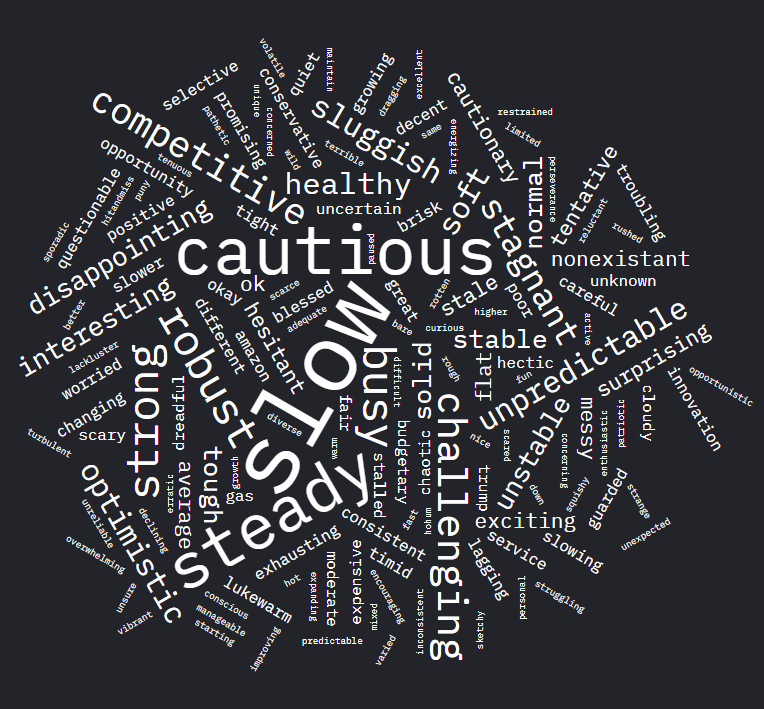
And even for distributors who have been keeping busy, the buyer hesitancy that characterized much of 2025 doesn’t seem to have completely dissipated.
Jason Pond, president of theLogoShop (asi/255308) in Utah, describes the second quarter as “soft.” Orders have still been coming in, but he has had to be significantly more proactive about reaching out and staying in front of core clients than is typically necessary.
“Projects for summertime haven’t been as robust as they have in years past,” Pond says. “We still have our core customers, we’re still servicing them and we’re busy – it’s just that we’re not overtime busy.”
Outside of his “use it or lose it” projects, Parsons, too, notes an overall trend toward lower order quantities, even as order volume and client interest has stayed consistent. Zeidman at Unforgettable Goods says the biggest sign of lingering uncertainty with the economy has been client unwillingness to give the OK to budgets or events as far out as they typically do. She’s had to fulfill so many rush orders this quarter because clients were wishy-washy on whether they were headed out to an event, she says.
“It seems like they’re just not wanting to commit to where or how they want to spend that marketing budget,” she says. “And then, they’ll make a last-minute decision to go to an event and need something in a week.”
High shipping prices haven’t helped in that regard, either. Lester, for example, fulfills an order for golf tournament promo for a particular client every year. This year’s shipping fee was nearly double last year’s, due to heightened energy and gas prices stemming from the conflict in Iran.
Bryan Goltzman, founder and president at Counselor 2026 Best Place to Work Liquid Screen Design (asi/254663), says changes like higher shipping rates, inflation or overall uncertainty typically don’t stop people from ordering altogether. Liquid Screen Design had a solid quarter, he says, that particularly picked up in June with a flood of orders for summer camps and high-end resorts.
But uncertainty lengthens the order process without substantially changing it, Goltzman says. If clients need promo, they’ll eventually order it, despite uncertainty.
“I don’t think that stops orders, I don’t think it stops decision-making,” he added, “but I do think it drags out the process a bit.”
Moving Forward
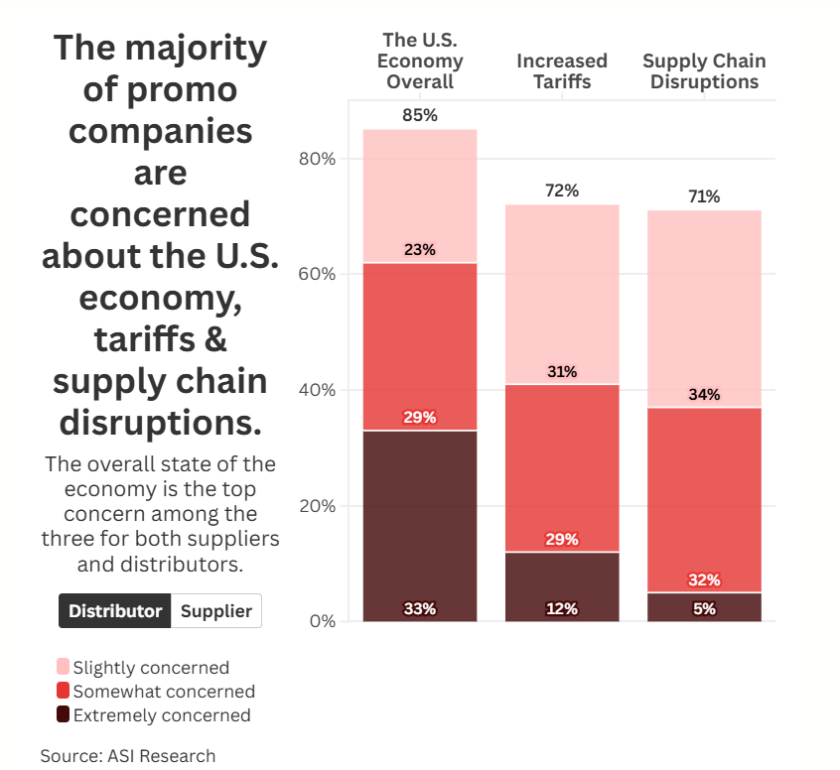
Many of the problems that have plagued the promo industry the past two years aren’t going anywhere. Prices are still rising, international conflicts remain ongoing and tighter budgets persist.
Those enduring pressures are reflected in the Counselor Confidence Index, which measures promo industry health and sat at 88 in Q2 – a one-point increase from the previous quarter. (The index’s baseline is 100.
The index’s end-of-year projection is slightly up from that at 92, which is identical to the projection that was forecasted at the start of the year.
Matthai, of Haymaker Promotions, said she suspects clients that cut marketing budgets last year during the peak of an uncertain cycle may be starting to feel the negative effects of doing so – and inching their way back to promo spend to counteract it. She’s had at least one client return after skipping a major project last year, for example. The client didn’t outright say they regretted not spending the money, but Matthai has her suspicions.
Overall, Haymaker’s Q2 was significantly better than expected, in large part thanks to another big order from a client that wasn’t originally on the docket. But she also says that it’s become increasingly important for her business to operate as more than just an order taker. It helps appropriately position her pricing – and demonstrate the value of working with a distributor, she says.
“Now, we’re able to say, ‘This is what it costs to work with us because we’re good at our jobs,’” Matthai says. “I think people are looking at us more as partners rather than a transactional company.”
Counselor Top 40 distributor Quality Logo Products (asi/302967) has taken a similar approach by increasing the “barrier to entry” to become a client, says President Bret Bonnet. Order count was down compared to 2025, but overall sales are up thanks to changes like increased order minimums.
Uncertainty in the world is always going to cause distractions, says Goltzman. But promo has its place in the marketing mix if companies can make that value clear.
“Businesses are always going to advertise,” says Brenda Mulberry, the owner of Florida-based distributor Pike Products (asi/295681), also known as Space Shirts. “They need to say who they are. They need to say what they do. And there’s nothing better than a T-shirt as a walking billboard.”
Read this full feature, complete with charts and research data, on Counselor.