
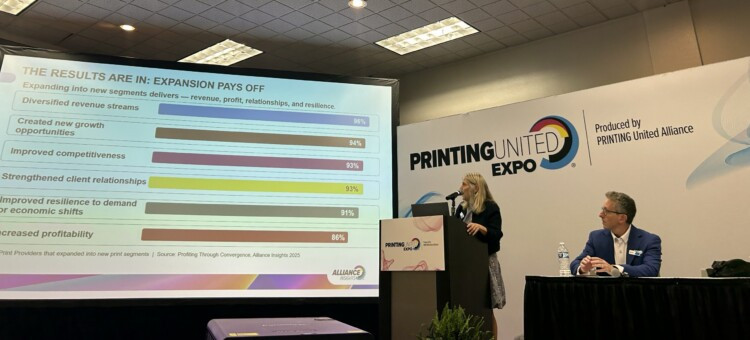
Convergence shows no signs of slowing down. According to Nathan Safran, VP of research at Alliance Insights, widespread diversification has resulted in the blurring of traditionally rigid boundaries between very different segments of the industry.
“In the past, it used to be: ‘I’m a commercial printer,’ ‘I’m a graphic and sign printer,’ ‘I’m a package printer,’” Safran said during a session at PRINTING United Expo 2026. “Now it looks more like this: ‘I’m a printer that does a variety of applications.’”
There are several factors making this confluence possible. Firstly, customer demand. In Alliance Insights’ third report on convergence, “Profiting Through Convergence,” 91% of surveyed print service providers (PSPs) reported that customers increasingly expect a one-stop shop experience when they are looking for print products. It means PSPs are expected to offer everything from brochures and direct mail to banners and promotional products; if they lack something the customer needs, they might lose their business altogether.
Secondly, 90% of PSPs reported that new technologies are making it easier to move into new segments. For instance, digital printing equipment can lower the barrier to entry into segments that have traditionally required deep technical expertise or equipment with niche capabilities, such as flexible packaging or labels.
The trend toward convergence has been traced for years now, but this latest report highlights the financial implications for PSPs.
Read the rest of this article on Printing Impressions, a publication of PRINTING United Alliance, ASI’s strategic partner.