
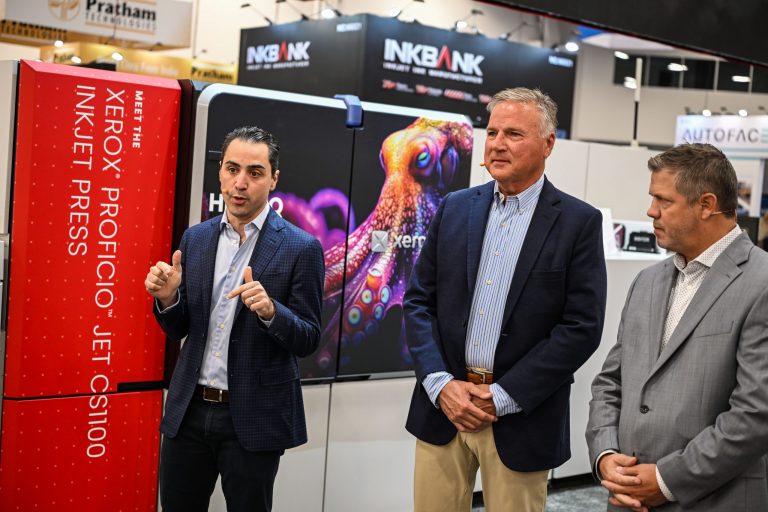
Xerox knows it has to work on rebuilding trust after it exited the iGen space. At the recent PRINTING United Expo in Las Vegas, I had the opportunity to sit down with Louie Pastor, CEO of Xerox, to chat about where the company has come from, and where it sees the future of the printing industry heading — and how Xerox intends to position itself in that mix.
The energy at the booth this year was strong, with multiple new product launches and a good crowd. But, Pastor noted, Xerox knows it has to work on rebuilding trust after it’s exit from the iGen space.
He said, “the customers were, ‘what does that mean for us,’ right? And we committed, orally and contractually, to support and service and supply them, and ensure that [they were] running reliably and consistently while we work on the new products that are coming next. And now to have had those customers go through that journey with us, but then see what those new products actually are and how they perform and how they’re differentiated — it’s very rewarding.”
One of those new products is the Proficio Jet CS1100 production inkjet press, which was officially launched at Expo, along with the introduction of the first customer, Goodway Group. It joins several other presses in the new Proficio line, and helps establish the portfolio Pastor sees for the future. “One portfolio, every print opportunity,” he stressed, which was also the tagline for the entire Xerox strategy going forward.
He explained, “we want to enable our customers to capture as much of the market that’s actually available to them. So focusing on the dynamics in those markets, as well as the challenges and opportunities that our customers have, and ensuring that our portfolio of offerings[meets those challenges], because it transcends hardware. It’s the software, it’s the supplies, it’s distribution, it’s service, it’s everything around it. Ensuring that we’re doing delivering it in a way that enables them to improve the outcomes of their business, both on the bottom line, so greater efficiency and productivity, but also to capture the market opportunities.”
That said, when he thinks about the future of the portfolio, he noted that Xerox certainly plans to broaden its offerings anywhere it makes sense to meet that mission, but it is also looking at partnerships where it makes sense.
Pastor noted, “does that mean we’re going to be in every single segment and subsegment? I mean, one of the interesting things about being at a show like [PRINTING United Expo] is you get an appreciation for how many niche applications and providers there are. So, do I envision a world where Xerox has one portfolio that literally encompasses everything that’s offered at a show like this? No, but I do think that over time, what you’re going to see is we’re going to continue to broaden out what we’re doing.”
In particular, he noted that the partnership with Xeikon that was announced in September is a good example of what to expect on that front, allowing Xerox to get into the packaging and label space through that connection, and Pastor noted that there will be more to come on that front, as well as additional partnerships in the future.
A Changing Industry
When it comes to the trends Pastor is looking at, that are shaping not only the Xerox strategy today, but also where it will go in the future, one of the big ones has been the rise of high-speed inkjet displacing both offset and toner in a wide range of applications. And the quality of what is coming off those presses, he stressed, would have been impossible even 10 years ago. The technologies have evolved quickly, and Xerox has needed to evolve with it.
Read this full article on Printing Impressions, a publication of PRINTING United Alliance, ASI’s strategic partner.