
Key Takeaways
• Eclipse glasses can create huge event-driven promotional product demand.
• Last-minute buying in Europe caused shortages and missed sales opportunities.
• Distributors who anticipate celestial events can pitch branded glasses across nearly any market.
Since the dawn of humankind, we have looked to the sky in the hopes of understanding our universe. We’ve sought answers to our myriad questions about our place in the stars. As humanity has developed we’ve built stories and mythologies to try to make sense of it all.
Despite what your human instincts tell you, leading scientists say that it’s not a good idea to stare directly into a solar eclipse.
Bummer, I know.
The good news for promotional products pros is that scientific party-pooping leads directly to sales – thanks to eclipse glasses, which can be given out or sold and make staring directly into the total eclipse much safer and more enjoyable.
On Aug. 12, viewers in Europe got to take in a total solar eclipse, where the moon passes directly between the sun and the earth. It was the first visible in mainland Europe in 20 years, and it lasted about two minutes.
The promise of those two minutes was enough to drive demand for eclipse glasses – many of them branded promotional items – to the point where many hopeful viewers in the U.K. were left out.
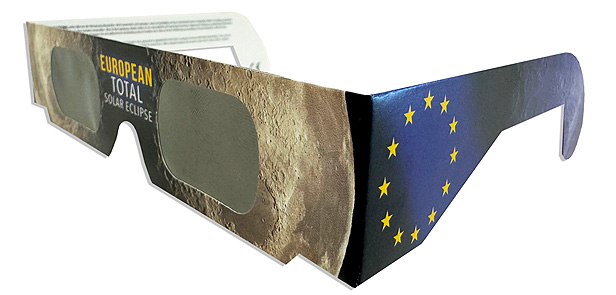
According to The New York Times, there were dedicated social media groups reporting on stock alerts and tips on where people could snag a pair last minute. The Times reported, for example, that the Royal Observatory Greenwich said in a statement on Tuesday morning that it had a “very limited” number of glasses available onsite for a watch party (after already selling out online), but ended up without any only hours later due to what it called “an unprecedented volume of orders.”
Part of the huge demand for these products, which could also qualify as print products since many are made from paper, is that London, for example, won’t get another eclipse like this for almost 60 years. The path of the eclipse also included major cities like Madrid, Paris, Milan, Barcelona, Lisbon, Dublin and more.
Lili Yu, sales manager for Pacific Thinker Inc. (asi/75657), which supplies eclipse glasses, said that demand is purely event-driven. It’s as if Christmas or the Super Bowl weren’t anchored to specific days, and instead sort of snuck up on people.
“In non-eclipse periods, sales are minimal,” she said. “However, in the one to six months leading up to a major solar eclipse, demand experiences an intense surge, often causing temporary global supply shortages, like what the U.K. is currently experiencing.”
She added that she’s seen more robust planning for these events in North America, where suppliers might track astronomical calendars for six months to a year out in order to ensure inventory. Ahead of the last eclipse visible from the U.S., for example, ESP searches for “solar eclipse glasses” spiked nearly 5,000% as distributors prepared accordingly.
“In contrast, smaller markets or localized events often see last-minute panic buying, resulting in swift stockouts,” Yu added. “The last total solar eclipse in the U.S. was April 8, 2024. When we listed solar eclipse glasses on our store in 2024, inquiries surged almost immediately, and that high demand lasted straight through the end of March.”
John Jerit, president of American Paper Optics (asi/35591), another supplier that specializes in solar eclipse glasses, said that his company did well in Europe leading up to this eclipse, but still believes that many customers waited until the last minute, which led to the shortage.
American Paper Optics saw significant business selling to tourism and hospitality clients like hotels and cruise ships across European countries like Iceland. The company also found success with dedicated astronomy companies in the likes of Germany, but he believes the difference between U.S. demand and European demand comes down to how ubiquitous the products are and how easily customers can get their hands on them as they go through their daily lives.
“We sell to major retailers like Kroger, Lowe’s, Home Depot, Cracker Barrel and Walmart,” Jerit says. “They all bought our glasses, so they’re easier to get.”
Jerit added that, ultimately, European end-buyers were similar to American end-buyers: They just procrastinated. American Paper Optics sold about half of the 35 to 40 million units they were hoping to move ahead of the eclipse, which Jerit partially attributes to more regulations selling in Europe and an abundance of small-scale orders.
“We sold more orders, branded and printed orders, in Europe for this than we did in the U.S., but the orders were small – they were 500 to 1,000 units,” Jerit said. “Whereas here, I make 2 million for NASA and 5 million for the U.S. library system.”
Branded Opportunities Are Clear To See
When the public gets excited about a natural event like this, it feels doubly special since most people don’t plan for it years in advance. Once it hits the mainstream news cycle, it’s almost here, so it does give off that feeling of blink-and-you-miss-it hype.
This creates an opportunity for distributors to sell to virtually any sales vertical. In Europe, for example, soccer fans took in the eclipse outside of their teams’ stadiums before matches – which could have been an opportunity for a bonus game-day giveaway.
Fans across Europe took in the solar eclipse before their clubs' matches ☀️😎 pic.twitter.com/PiLJtYi9nY
— B/R Football (@brfootball) August 12, 2026
It might be a college that gives out branded glasses with a department message on them, or a local business with a clever marketing message printed on the glasses given out to people who stop in. From there, distributors can bundle in other promotional products that promote a brand and tie in with the festivities of the eclipse.
The opportunities are endless, because celestial events are (literally) universal.
Plan Ahead
The lesson from this recent eclipse in Europe is that distributors should do the planning for their customers. Business owners most likely do not have the paths of the sun, moon and earth committed to memory. Distributors who plan ahead for events like this and present the opportunity to end-buyers with enough advance notice will be the ones who land and, most importantly, have time to fulfill the orders.
You might need a good almanac to see where and when the next eclipse events will be, but you don’t have to be any great astronomer to find customers and end-users who will want these products.