
In direct-to-film (DTF) technology, artwork is inkjet-printed onto an intermediate film that can be transferred using heat onto cotton, polyester, and other fabrics, as well as treated leather. Once prepared, the transfers can be used immediately, stored for later use, or sold as a final product.
In simplest terms, the transfers are printed with the color layer first, then with the white base. After printing, and while the ink is still wet, the graphic is coated in a powdered adhesive, which must be heated to cure. A critical step in the DTF process is thorough and uniform adhesive curing. A properly cured transfer will have a glossy, orange peel texture.
Printed transfers are generally cured using one of four types of equipment.
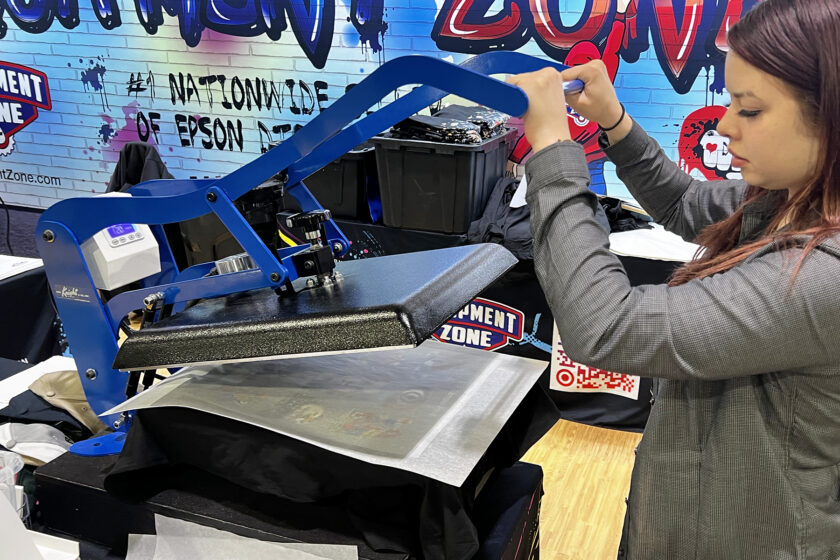
Heat Presses
To cure the transfer on a clamshell heat press, the bottom platen should be heated. For presses without a bottom heating element, the press can be closed for 30 seconds to heat the bottom platen. Lay the transfer with the adhesive side up on the bottom platen and hover the top platen above the transfer as closely as possible without touching. For swing-away models, set the machine to hover just above the transfer without making contact.
Dwell time and temperature will depend on the make of heat press used, but estimate between 1 and 5 minutes per transfer at 275 F to 350 F.
Since most direct-to-garment (DTG) and DTF shops own a heat press, this option is likely already available. However, using a heat press to cure DTF adhesives requires operator time and attention, and prevents the heat press from being used for other tasks, potentially creating a bottleneck in production. Most operate on 120V and should be operated below a separate powered exhaust hood to evacuate fumes. Average cost ranges from $200 to $2,000 depending on brand and features.
Curing Ovens
Designed to cure individual sheets of DTF film up to 18×24″, curing ovens are single-function devices that provide uniform heating at temperatures to 300 F. Once the oven is heated to the desired temperature, the transfer sheet is inserted into a tray that slides in and out to retain the heat inside the body of the device. An automatic timer and alarm signals the operator to remove the transfer. A typical setting is 260 F at 120 seconds. A fume extractor or separate powered exhaust hood is strongly recommended.
Most curing ovens operate on 120V and fit on a tabletop or counter. Average cost ranges from $200 to $1,000.
Read this full article on Apparelist, a publication of PRINTING United Alliance, ASI’s strategic partner.