
SEDDI launched about eight years ago to answer a universal question: Why can’t you try on clothing online?
To the uninitiated, it may seem like a simple enough dilemma, says SEDDI CEO Alan Murray, but “it turns out to be a really complicated problem” to create an accurate digital representation of how fabric will drape and flow on a human body. But, he adds, “Our vision of the world is that we should be able to put any piece of clothing on any body and anybody and reflect accurately how that garment’s going to fit and look on them.”
After several years of research and development, SEDDI came up with a method for translating apparel to the digital world: “We construct garments digitally almost exactly the same way they’re stitched and sewn in real life,” Murray says. “So, we have a digital bill of materials, which is a parallel to the physical bill of materials for how a garment is constructed.”
All the details you would find in a garment’s “tech pack” are input digitally, and SEDDI’s technology assembles the digital garment in its platform in the correct sewing order, with the correct seams and stitches. Once the digital 3D garment is created, SEDDI can drape it on a digital representation of a body and “perform some pretty complex simulation in the cloud” to show how the material drapes, stretches and folds when worn, according to Murray.
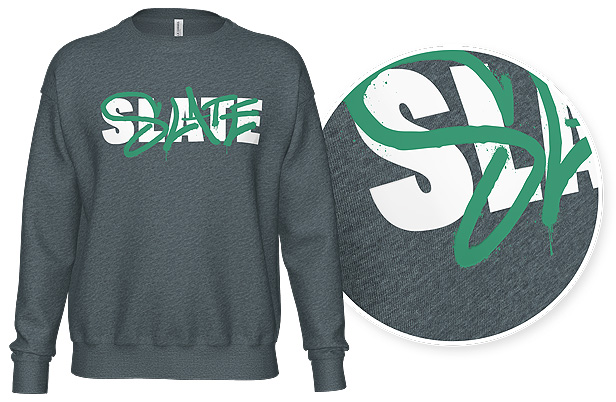
SEDDI’s technology allows apparel brands to design and develop apparel collections and fabrics digitally – but the company also sees application in the promotional products space. It recently launched Decorator, which it calls the first all-in-one 3D platform for branded apparel. SEDDI worked with leading suppliers in the promo industry, adding individual styles – spec by spec – into its digital library, so that distributors can then create photorealistic mockups on blank styles, speeding up the sales process. The differentiator from other virtual sampling tools, SEDDI says, is that the digital file is both accurate and production-ready, which the company refers to as a “visual source of truth,” thus eliminating time-wasting back-and-forth between sales and production.
“Decorator is becoming the visual front end for the branded apparel value chain,” Murray says. “A single workspace where everything you need to create, approve and produce designs lives.”

SEDDI also incorporated AI into its tech, enabling instant lifestyle imagery generation, so that distributors and decorators can showcase on-model branded apparel in lifelike settings. Murray is quick to point out, however, that the company doesn’t allow AI to modify its apparel simulations, since they need to be true to life. “We don’t let the AI mess with that,” he says. Instead, the company uses “AI inpainting” to create photorealistic background imagery.
Decorator’s library of available blanks continues to grow, as SEDDI digitizes dozens of new styles each week in collaboration with suppliers, though Murray admits that in an industry with millions of SKUs, reaching 100% coverage is something of a pipe dream. Instead, SEDDI has focused on demand, letting customers drive which brands and styles are most important to add to the system.
BELLA+CANVAS (asi/39590), one of the suppliers that’s been collaborating with SEDDI, praised the company’s innovation.
“In our industry, accuracy isn’t just nice to have – it’s game changing,” says Victoria Thomas, senior director of marketing at BELLA+CANVAS. “With SEDDI Decorator, distributors and decorators see exactly what they’ll get with BELLA+CANVAS, which means faster decisions, fewer surprises and more creative freedom.”