
To Rusty Pepper, there are really two options at this point for print and promo businesses.
“Embrace print on demand, or risk going out of business as the world is rapidly moving from analog to digital,” says Pepper, head of global markets and partnerships for Taylor Corporation, parent company of Counselor Top 40 distributor Taylor Promo Marketing (asi/333647), Counselor Top 40 supplier ADG Promo Products (asi/97270) and print-on-demand fulfillment company Gooten.
In a world where speed is paramount – same-day shipping, immediate downloads – there’s very little patience among consumers. The nature of decorating and delivering promotional products and branded merchandise is no different.
“In a digital-first era, a much smaller, more agile company that fully embraces print on demand can compete with, and often beat, a much larger and established company that still relies on slow, analog processes,” Pepper says. “Print on demand is an absolute competitive advantage because it helps businesses grow faster, be more agile and stay relevant in a digital-first world.”
Print on demand is redefining innovation by helping print and promo companies become leaner, faster and more agile.
What does it mean, though, to embrace print on demand? As Pepper notes, it involves transitioning from analog technology to digital, which has a learning curve. Every step of the ordering process, decoration process and delivery is different. It’s not as simple as just buying a new printer that sticks the ink onto a shirt in a more efficient way.
For those uninitiated, or who might still be a little unsure what “print on demand” or “POD” means, here’s the most succinct definition: decorating products that directly correspond with demand. Say you’re printing apparel for an event. Rather than guess how many pieces you would need and potentially end up with dead stock or not enough to go around, you’d order, decorate and ship based on immediate demand.
Print on demand empowers sales reps – whether they’re distributors, decorators or a combination of the two. “With the old model, everything revolves around bulk production, long lead times and inventory,” Pepper says. “Buyers must forecast their volumes, distributors act mainly as order takers and value flows upstream to whomever owns the equipment and inventory. But print on demand flips that dynamic since production only happens after orders are submitted.”
Evolution in Action
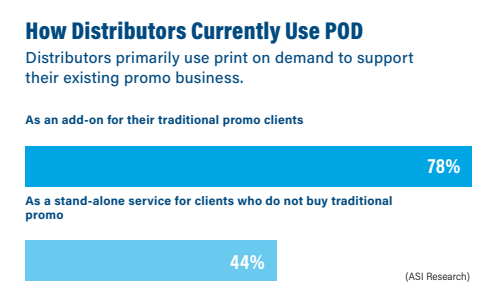
In addition to new companies popping up that are built on the print-on-demand model, the technology and its prevalence has shifted the way even traditional suppliers and distributors run their businesses.
Take Counselor Top 40 supplier PCNA (asi/66887), which introduced the Spoke Custom print-on-demand brand within the company after acquiring it in 2022. Originally, it had started out as part of Case-Mate to fill the need for print-on-demand phone cases in 2013. From there, the supplier grew Spoke to be its on-demand, low-minimum-order quantity and high-agility arm of the brand to handle the more traditional side of PCNA’s business. Users can choose Spoke as a vendor when selling products on e-commerce platforms or their own merchandising business.
“In many ways, Spoke was built a decade ahead of where the market was going,” says Doug Mitchell, chief growth officer for PCNA. “Thus, by the time PCNA acquired it, the operation was already optimized for the on-demand era distributors are now entering.”
During its growth period from inception to acquisition, Spoke had grown beyond simply phone cases to include new products, decoration methods and equipment, as well as new partnerships within the industry.
“Together, PCNA and Spoke form a hybrid model,” Mitchell says. “PCNA delivers scale, logistics and on-trend promotional product development strength. Spoke delivers agility, personalization, rapid turnaround and ever-increasing SKU specialization. The impact for distributors is clear: This hybrid model empowers them to say ‘yes’ to more promotional opportunities than ever, from 10,000-piece national activations to a single personalized gift for a VIP.”
The Power of Personalization
Mitchell’s point about personalization hits on a key trend in branded merchandise and gifting: People want things that feel like they’re tailor-made for them. Print on demand allows for greater personalization for a custom gifting experience beyond just names. It incorporates the most up-to-date design trends and creates something specifically for one event.
“Today’s buyers don’t just want products, they want relevance,” Mitchell says. “Print on demand makes it possible to match artwork or personalization to a moment, an event or even an individual without the slow, inventory-heavy processes of traditional decoration.”
Brian Richards, Northwest regional sales manager for Kornit, specializes in the POD side of the print equipment firm. He’s of the belief that it’s no longer a “nice to have.” It’s a must-have.
“Print on demand as a model of production is in the life stage right now where it’s transitioning from something that early adopters and e-commerce-focused businesses implanted to something that’s closer now to mass adoption,” he says. “A lot of people will point to the pandemic as this tipping point when online business surged and brick-and-mortar slumped, but there’s no doubt a trend within apparel decoration as a whole toward smaller runs and more flexibility. The market is now starting to demand it.”

“Print on demand makes it possible to match artwork or personalization to a moment, an event or even an individual without the slow, inventory-heavy processes of traditional decoration.”
Doug Mitchell, PCNA (asi/66887)
While a company can spot demand and have every intention of adopting print on demand, it’s not as simple as snapping one’s fingers and making it so. It often comes with additional, complementary tech from what they might already have in house to allow for the immediate turnarounds.
That said, print on demand does limit investment in some areas.
“You’re not pre-buying 500 hoodies hoping they sell,” says Kevin Oakley, co-founder and chief revenue officer for Stoked On Printing and Merchloop. “You sell first, then we decorate and ship. That’s huge for cashflow and for people who are scared to guess on sizes or styles.”
“At its core, print on demand creates new revenue streams, de-risks expansion and meets customer expectations for speed and flexibility better than other, more traditional approaches,” Mitchell says. “For suppliers, it means deeper catalogs without the warehouse burden, more personalized SKUs, faster turnaround and stronger margins by eliminating unsold inventory. For decorators, it reduces setup time, enables true one-off production and opens the door to new decoration methods without expensive overhead.”
Complementary Tech
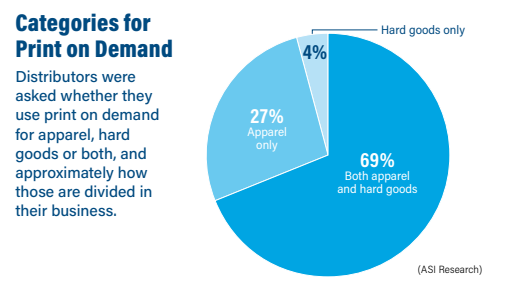
Certain decoration techniques lend themselves to the print-on-demand model. Direct to garment (DTG), for example, uses inkjet printers and digital technology to easily print quantities as low as one. Direct to film (DTF), a relatively new technique that has soared in popularity, qualifies as well.
“Direct to film has empowered businesses of any size to jump into on-demand production, while larger demand generators scale direct-to-garment productions with refined workflow operations,” Richards says.
DTF allows printers to print off a design onto film, rather than a screen, and store them for when they’re needed and apply them to apparel or hard goods when the order comes in.
“You’re seeing even traditional bulk screen printers realize that in order to thrive in this marketplace, they have to change and adapt to a more front-end, web-based experience for their clients who are being offered fulfillment and more modern purchasing experiences now everywhere they turn,” Richards notes.
“Print on demand isn’t a business model, it’s a tool.”
Kevin Oakley, Stoked on Printing and Merchloop
Pepper adds that along with DTF and DTG, sublimation printing is a way that decorators can get in on the print-on-demand game. Those aren’t the only options of doing business, though. Pepper says that these are decoration methods that can complement – not replace – more “traditional” methods like screen printing and embroidery.
“Print on demand expands what’s possible by enabling speed, personalization, small runs and zero inventory risk,” he explains. “The companies that win won’t choose one approach over the other – they’ll intelligently blend both, applying each method where it makes the most economic and strategic sense.”
That concept of intelligently blending methods and making informed economic and strategic decisions is important to keep in mind. Not every company can simply purchase a bunch of equipment – they might not have the space to do so even if they could afford it.
When considering jumping into the POD world, Oakley and others advise distributors and printers not to solely focus on print on demand. POD, like AI (more on that later), shouldn’t be a replacement for what you already have, but a means of making certain things simpler and more efficient.
“Print on demand isn’t a business model, it’s a tool,” Oakley says. “When we first started working on print on demand back in 2017, we fell into the trap of thinking print on demand was the business, so we went after the same saturated markets everyone else was chasing and tried to compete head-to-head. The real unlock came later, when we realized the question wasn’t ‘How do we win the print-on-demand market?’ but ‘Where can this technology actually solve real problems for the customers we already serve?’”
For decorators and distributors considering adding POD to their business, Oakley has a few pieces of advice.
“Start with one or two clear use cases, like a company store or a single brand’s e-commerce, and build backward from the experience you want the end-customer to have,” he says. “Don’t underestimate the operational and software side. The magic isn’t just ‘I can print one shirt.’ It’s ‘I can print one shirt profitably, accurately and repeatedly at scale.’ And don’t feel like you have to abandon traditional printing. Some of our best wins come from combining both models in smart ways.”
The Right Applications
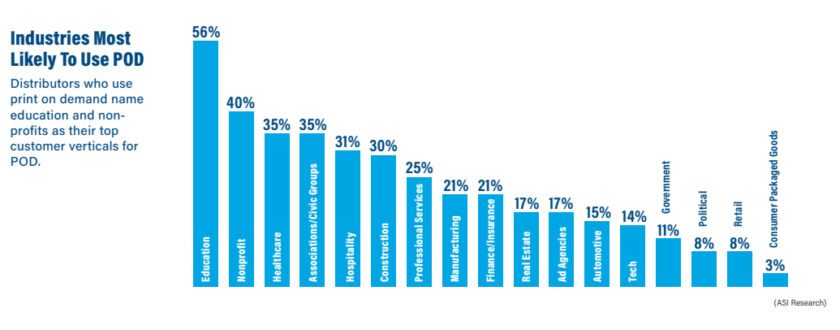
The applications for print on demand overlap with programs and campaign styles that are gaining prevalence with both younger buyers and a post-pandemic world where people want things as immediately as possible.
In an era where being an influencer is a highly sought-after career, too, upstart brands are using POD to grow without having to risk too much investment into materials.
“Anyone who wants to launch or test new designs regularly without sitting on a garage full of boxes, this is where print on demand is almost a no-brainer,” Oakley says.
Mitchell adds that POD is a good choice for projects that have a lot of variable data or require personalization at scale, such as team rosters. It can also work for events with unpredictable demand, such as a same-day event where a company prints T-shirts in person; or seasonal events where, as he puts it, “speed beats forecasting.”
Nothing, in Mitchell’s opinion, is more tailormade for POD than corporate gifting.
“Traditionally, printing every recipient’s personal name on an item, like a bottle, journal or tech accessory, would require large minimums, long lead times and complex kitting,” he says. “With print on demand, a company can produce thousands of individually personalized gifts, one at a time, without carrying any inventory.”
Pepper also says that POD can be used for things like A-B testing designs. A decorator or distributor could screen end-buyer favor without having to mass produce products.
In an era where streetwear-influenced drops are popular among brands, companies might do periodic “drops” with limited quantities, and POD can help drive demand and hype.
“Where print on demand isn’t the best fit is very large order volumes, projects that require highly specialized imprinting or decorating techniques, long lifecycle programs that can benefit from doing bulk production runs, and whenever traditional imprinting or decorating methods are more cost effective to use,” Pepper advises.
Traditional printing methods are often the right call for some decoration embellishments, especially on apparel.
“Because print on demand thrives on standardization, if you want out-of-the-box decoration placements, mixed-media decoration or specialty inks like HD, puff, gel and metallic, that’s still better suited for a traditional decoration technique,” Oakley says.
The Outlook
Print on demand is still a relatively new technology. Its use is widespread and growing, but it’s far from a complete product. As the experts point out, POD isn’t a single, monolithic thing that you can base a company around. It’s an ecosystem made up of a host of tech and strategies, each one innovating on its own and pushing the whole print-on-demand movement along.
Within the nuts and bolts of printing, Pepper is most excited by the continued development of UV direct-to-film printing and its usage in POD.
“It’s faster, more reliable and scalable for the print-on-demand market,” he says. “Thanks to improvements in materials and adhesion, it can now be used on both non-porous and semi-porous hard goods like drinkware, tech accessories, signage, packaging, metal, plastics and even coated paper products.”
Mitchell, from the perspective of someone working with a traditional supplier with a dedicated print-on-demand arm, is looking at innovations in the space in increments of two, five and 10 years.
In two years, he says, there will be deeper integration between POD systems and commerce platforms like Shopify, as well as continued improvements in turnaround time thanks to growing automation on production lines. He believes that in this period, more brands will shift 10%-20% of their SKUs to on-demand decoration workflows, and DTF will become even more accepted on an industry level due to its cost effectiveness, durability and versatility.
Mitchell says that within five years, POD will become the default method for personalized goods, and automation will continue to improve.
“Robotics will handle a larger share of routing, pretreating, pressing and quality control,” he adds.
Within the decade, Mitchell believes there will be fully autonomous production floors for print on demand, and AI will continue to evolve as a tool to allow for trend forecasting in real time and tie in with artwork generation and inventory modeling.
And, as environmentalism remains a focus, near-zero waste manufacturing will be an industry sustainability requirement – not an option.
“Global supply chains will shift to a hybrid model where traditional bulk and print on demand operate seamlessly as one network,” he says.
AI is the topic du jour right now in the industry, perhaps more than POD. Everyone is experimenting with different AI platforms like LLMs and artwork generation, in addition to existing uses like inventory management.
Richards notes AI has already made a big impact in the world of print, and that will continue.
“First it was the ability to create artwork easier,” he says. “Now it’s moving into the ability to serve the customer and execute a transaction easier with AI agents and workflows facilitating orders online, rather than a human having to pick up a call and/or send an email.”
He calls robotics the next “exciting” frontier.
“We’re not far off from bots on the show floor that can connect the missing links that exist today,” he says. “You already have had this surge of automation in decorated apparel systems that have reduced labor-intensive processes with better tools, but there’s still a gap that exists today where you need a human to connect placing and removing the garment between system, conveyer, folding, packaging, etc. But it won’t be long until those touch points are done with robotics. Give it five to 10 years before those solutions are not only out there but are being mass adopted.”
It all sounds very Westworld, but it’s not too far-fetched. At one point, the idea of using artificial intelligence to manage orders in real time and decorate at the drop of a hat seemed futuristic, and now it’s simply the norm.

“You’re seeing even traditional bulk screen printers realize they have to change and adapt to a more front-end, web-based experience for their clients who are being offered fulfillment and more modern purchasing experiences.”
Brian Richards, Kornit
It’s Ultimately About the Customer
Like AI, print on demand is a tool that should be wielded correctly. You wouldn’t just use it for the sake of it, or because you invested in equipment and software. The idea is to implement it with a clear goal in mind. According to Richards, the end goal should always be the customer.
Your usage of modern technology like DTF and DTG printing tied in with print-on-demand capabilities through platforms like e-commerce or company stores shows one thing that every customer in every vertical and industry in history wants to see: You care.
“I’m a consumer, too, and I always try to support small businesses, but I appreciate when those companies don’t make it feel like I have to work harder in order to shop with them,” Richards says. “You don’t need an angel investor to grow your business, but you do have to take proactive steps to show your customers that you’re doing the little things to make their lives easier.”
You’ve probably heard by now that “print on demand is here to stay.” What isn’t being said is that you need to go out and spend money on new equipment or a bigger warehouse. It’s shorthand for the fact that POD is part of a larger shift in decoration, sales and consumption in the promotional products industry.
Alongside the other innovations that make it possible like better and faster printing, sales and management platforms and software that use AI, and greater reliance on automation, the industry will continue to move into the future.
“At this point, print on demand won’t be the alternative,” Mitchell says. “It will be the infrastructure that keeps the industry moving.”
The Starting Line
Interested in adding print on demand to your business but don’t know where to start?
Direct-to-film (DTF) printing is a common entry point that allows for high quality decoration on a variety of substrates without having to invest in a ton of expensive equipment. DTF also allows for creating new revenue streams to other decorators or businesses.
“I can have a printer and I can sell transfers to other local businesses,” Rob Super, CEO and founder of American Print Supply, said during a session at the 2025 PRINTING United Expo in Orlando. “I can make a good margin just selling the transfers. That’s about as easy as it gets in the decoration world – printing something on a quality DTF printer, rolling it up in a tube, having it delivered or having customer come pick it up. And that’s good money that can supplement your decoration business right there alone.”
Decorators can use direct-to-film printing and combine that with in-person pop-ups at sporting events or festivals for items like T-shirts or bags. Rather than doing direct-to-garment printing on-site, DTF allows for unused transfers to be used later on different substrates.