
Key Takeaways
• AI-powered search is reshaping SEO, making citations and visibility increasingly important alongside traditional clicks and rankings.
• Original, authoritative content and optimized videos can help print and promo businesses gain visibility in AI-generated search results.
• Businesses should prioritize concise, informative content and adapt their SEO strategies to improve AI search visibility and conversions.
For Michelle Burson, search engine optimization has never been particularly easy.
The director of marketing at commercial printing and marketing fulfillment provider Artisan Colour says that when someone enters “print” or “printer” into a search engine, it could mean many different things.
“Do we know if they’re a business or an individual looking for printing?” she asks. “Are they looking for a home printer? Are they looking for a small job or a high-volume one? That search yields a variety of disparate results.”
Now, with AI chatbots and Google’s “AI Overview” rewriting the traditional rules of search, that concern has multiplied. Gone are the days of keyword optimization tools and measuring engagement by clicks alone. Today, the stakes are higher, the competition fiercer. Print and promo firms can still leverage SEO in the AI era to garner leads, engage with prospects and drive more business. How they do it is more nuanced than ever.
A Tale of Two Bots
While many believe that SEO is a victim of the AI era, SEO practices are still alive and well – they just look vastly different than they did a few years ago.
“SEO isn’t dead,” says Jacob Hoehne, a marketer and the founder of Findable.Video, a platform that optimizes the text accompanying YouTube videos (titles, descriptions, captions, etc.) into citable, legible and findable content. “SEO is still the foundation that AI is built on.”
But before print and promo businesses start messing with their existing digital marketing infrastructure, they should be able to define a few key terms.
Search engine optimization (SEO), Hoehne explains, helps search engines find and rank a page, while answer engine optimization (AEO) optimizes elements like metadata, web text and FAQs so the content can appear as a single direct answer. The goal is to show up in a featured snippet – a brief paragraph, bulleted list or table that answers a specific user question by pulling from a single source. Last is what’s called generative engine optimization (GEO), which helps position content to become a cited source AI uses to build a synthesized answer, combining information from multiple websites to answer complex and sometimes multipart prompts. An AI-generated answer synthesizes information, while a featured snippet displays an excerpt from a web page.
“There are two different but equally powerful bots,” Hoehne explains. The first bot is the slow one. It indexes web pages, creating a searchable repository of information, thus creating a larger warehouse of data. The fast bot, by comparison, is “really impatient,” Hoehne adds. “It’s not going to do thorough research,” he explains. “It’s going to go grab the first available answer and come back with it. But it’s pulling from the warehouse that the indexing bot has already assembled.”
He uses the metaphor of a library to further differentiate between SEO, AEO and GEO. “SEO is getting your book on the shelf,” Hoehne wrote in a recent blog post. “AEO is the librarian opening your book and reading the one exact answer aloud. GEO is the librarian reading a whole stack, writing a briefing in their own words and crediting the sources they used. SEO is being found, AEO is being the answer, GEO is being built into the answer.”
Focus on Citations, Not Clicks
One of the biggest differences between the “pre-AI” and “post-AI” search eras, Hoehne notes, is that before AI search, brands measured success through clicks.
Now, Google’s AI Overview and AI chatbots have turned that process completely on its head.
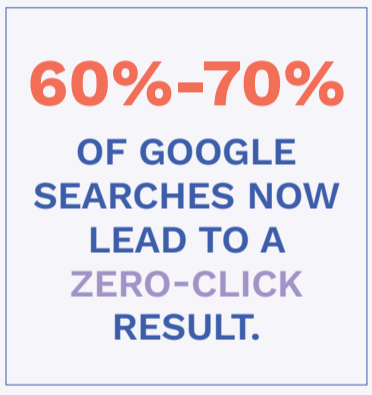
“Across the board, people are feeling a dip in their organic search results,” says Hoehne, pointing to the jarring statistic that between 60% and 70% of Google searches now lead to a zero-click result. “Very few people are clicking on a link to get their search results.”
Instead, AI search and chatbots pull information using citations. For brands looking to generate brand awareness and leads, Hoehne recommends moving away from tracking clicks and toward measuring citations.
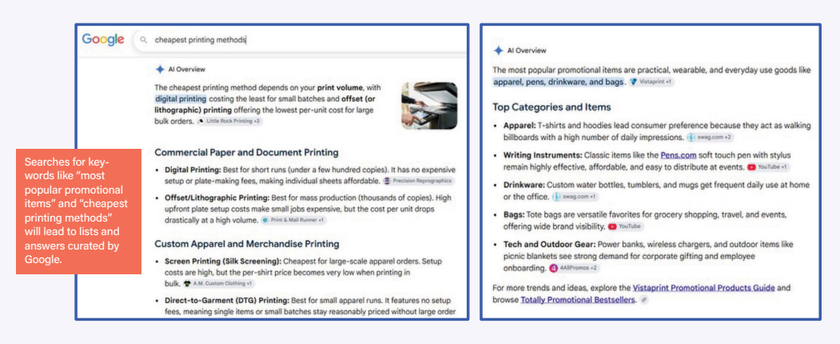
For instance, say someone conducts a search for the “cheapest print methods” or the “best promotional products for sales reps.” AI will scrape the web and come up with a list, citing various articles or blogs in its answer.
But when it comes to citations, Hoehne says more brands should focus on optimizing their video content for AI discovery and readability. YouTube ranks among the most cited sources across AI search, but according to Hoehne, many companies aren’t putting in the work to make their videos discoverable.
“You might have great video content, but if you haven’t optimized it, the AI is going to turn around and cite another company that has,” he explains. “So, the work to be done is actually to optimize the metadata, or the text on your YouTube videos so that AI can read it.”
Writing for the Robots
It may seem counterintuitive, but AI tools don’t favor content generated by AI. Instead, they prefer fresh, well-written and thoroughly researched information. (Google says it rewards “high-quality content, however it is produced.”)
“When you ask AI to create content, what it’s doing is it’s being safe,” explains Patrick Whelan, the founder and president of Great Reach Communications, a digital marketing agency that exclusively serves the print, mail and packaging industries. “It’s pulling an average of everything it finds.”
Instead, Whelan says, AI wants to cite content that meets four key criteria in a framework known by the acronym EEAT: experience, expertise, authoritativeness and trustworthiness.

Burson of Artisan Colour says that while many marketers may be tired of hearing about EEAT, there’s a reason people talk about it so much.
“It’s all about making sure you offer differentiated content and a consistent theme, because AI is skimming, and it’s skimming fast,” she says. “It wants to find your content as quickly as possible.”
Burson advises print and promo companies to “find the things only you or your company can talk about.” A writer at heart, she once had a lot of fun crafting clever intros for articles on the company’s blog.
“Now, we just start with the table of contents,” she says. “I don’t think it necessarily looks good aesthetically, but it does work in helping AI find relevant information quickly.”
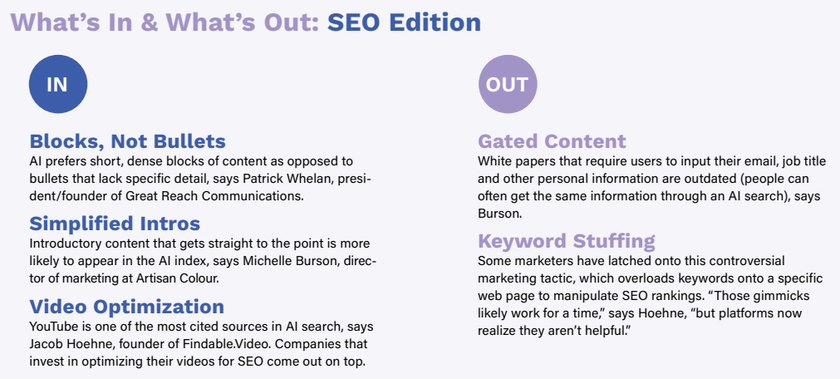
Whelan adds that he’s heard his fair share of misconceptions about how to write for AI. “People said for the longest time that AI likes bulleted content and numerical content – and they’re still saying that,” he notes. “But we found that’s not the case … it doesn’t like it anymore. AI knows AI and AI doesn’t trust AI.”

“AI knows AI and AI doesn’t trust AI.”
Patrick whelan, great reach communications
Others have recommended writing for the answers in what Whelan calls an effort to “win the prompt wars.” Essentially, people assume that if they generate more content and stack potential answers into their writing, they will increase the probability of being picked up by AI.
Whelan points to one direct mail company in Michigan, which has continuously appeared in AI searches for its local area despite not having a ton of content. He believes the company’s SEO success can be attributed to a high signal-to-noise ratio, a marketing theory that measures the proportion of meaningful information relative to low-value content or data. “That direct mail company provided everything in short, dense blocks of content, which we’ve found AI tends to prefer.”
An Evolving Space
Burson says that measuring SEO success used to be relatively straightforward. She and her team regularly turned to tracking platforms like Google Analytics, HubSpot and Semrush to measure clicks, engagement and overall rankings. That was before AI search changed the game.
“There’s no way to see where you rank anymore,” she says. “AI search obliterated this entire recipe we created.”
Now, Burson takes a qualitative approach to measuring success. When prospects reach out to her team, she asks them not only how they found Artisan Colour, but also what they searched for and what sorts of answers came up. But there’s a large gap in this data, Burson notes. “Right now, there’s no way to see who didn’t convert,” she says, although platforms like HubSpot are beginning to include more of this information. Burson expects other tracking platforms will follow suit as AI search evolves.
Natalie Whited, enterprise vice president at Orbus Visual Communications Group (asi/75209), adds that Google Analytics has a new classification called “AI-specific traffic,” but that feature isn’t available to everyone just yet.
“We’ve seen a shift from referral-based category traffic to AI traffic,” she notes. “Google is recognizing that AI needs to be tracked as a channel and we’re seeing that across more of our brands.”
Orbus has also adopted new tools that help its marketers gain insight into what LLMs actually see from the company’s website. “It gives us a grade or a score,” she says.
Many print and promo companies, Whelan adds, are turning to social media to drive engagement, but he advises marketers to instead look to platforms that will prioritize conversion.
“Social media is in its decline as a marketing tool,” he says. “You can get all the likes you want, but at the end of the day, if these people aren’t converting, you’re wasting your time.”
Of course, improving SEO isn’t something that happens overnight – and it requires a fair amount of trial and error.
“It’s another investment,” Whited says. “You need to make sure that you’re allocating not only dollars, but time.”
Whelan adds that while he recognizes the level of commitment SEO now requires, print and promo companies shouldn’t wait too long.
“Trust is a huge factor for AI,” he says, referring again to the EEAT framework. “Companies that get in early will get the benefit of better SEO, because the longer you’re in the AI index, the more it trusts you. So, I wouldn’t wait. Many companies are missing the boat.”