
“We’re going to focus on a number of things that will add value to you as our customers.”
Brent Pietrzak, CEO of CAI Software, made that note about the company’s strategy for the future during the opening session of the 26th CONNECT event this week in Las Vegas, Nevada. The agenda delivered on that promise on day one of the event, as Nathan Safran, vice president of Research at Alliance Insights, took the stage shortly after Pietrzak. Safran offered attendees a look at key challenges ahead of 2026 and how industry leaders are responding.
He shared that among print service providers (PSPs) surveyed, the key concerns were increasing sales, maintaining profitability, economic business conditions, rising labor costs, rising substrate costs, and the effects of tariffs on costs, supply chains, and workflow. He then identified four specific ways PSPs are addressing these challenges, with 71% focused on productivity and finding ways to improve efficiency; 70% focused on controlling costs; 69% focused on automation, reducing steps, and streamlining processes; and 52% capturing higher-value, more profitable sales.
When it comes to productivity, he noted that rising input and substrate costs, along with ongoing labor constraints, wage pressure, margin compression, and customer demand for faster turnarounds are all drivers pushing the “productivity imperative.” There is an opportunity, however, to improve workflows, reduce process friction, and increase throughput without additional overhead or labor. One way to prioritize those factors is through investment, and while he noted that some PSPs might become overly cautious in times of uncertainty, it’s important to continue investing and to align those capital investments with operational efficiency goals. Across commercial printing, graphic and sign printers, and label and packaging printers, AI and business intelligence systems ranked at or near the top of investment plans for 2026.
“The way that we think about it is, it’s a good time to invest,” he said. “You’re investing in equipment that gives you greater automation and greater productivity. You’re addressing your whole line, you’re addressing finishing, and the whole stretch of your software to identify where you can improve so that you can make yourself more competitive, so that you can separate from the competition, so that you can get into new areas of business.”
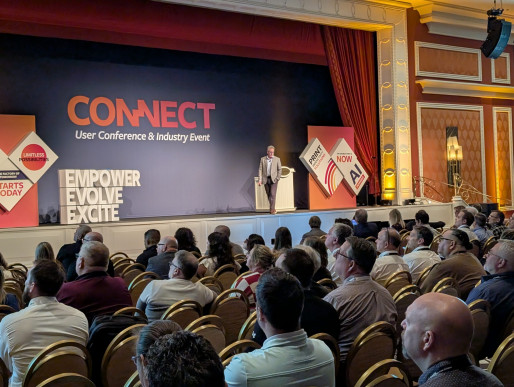
To address the cost-control mandate, Safran noted that PSPs report trying to “find and plug leaks” and to keep an eye on expenses.
“How do you turn automation into a competitive advantage?” Safran posed. “Treat it as a survival strategy, not as a nice-to-have.”
While automation is the focus of industry research, education, and events, Safran reported that 67% of respondents in one of Alliance Insights’ surveys said they are minimally or not automated at all. When the team looks at it year over year, the level of automation in the industry is making slow progress, Safran said, but there is room for improvement.
“The good news is, 57% of you told us that you’re seeking automation features on equipment or workflow,” he said.
Read the rest of this story on Printing Impressions, a publication of PRINTING United Alliance, ASI’s strategic partner.