
The best thing a customer can be is reliable. Repeat orders are like gold in any industry – but especially in print and promo products.
Look at jumbo roll printing. Beyond the impressive sight of giant reams of paper, what does it signify? Demand – a lot of it. The nature of pieces printed on jumbo rolls implies a certain level of need where the only way to meet it is through massive rolls of paper.
And the best part is that demand can be a repeat source of sales year after year. Whether you’re printing jumbo rolls or primed to expand into this field without investing in print equipment yourself, here’s what you need to know.
That’s A Lot of Paper
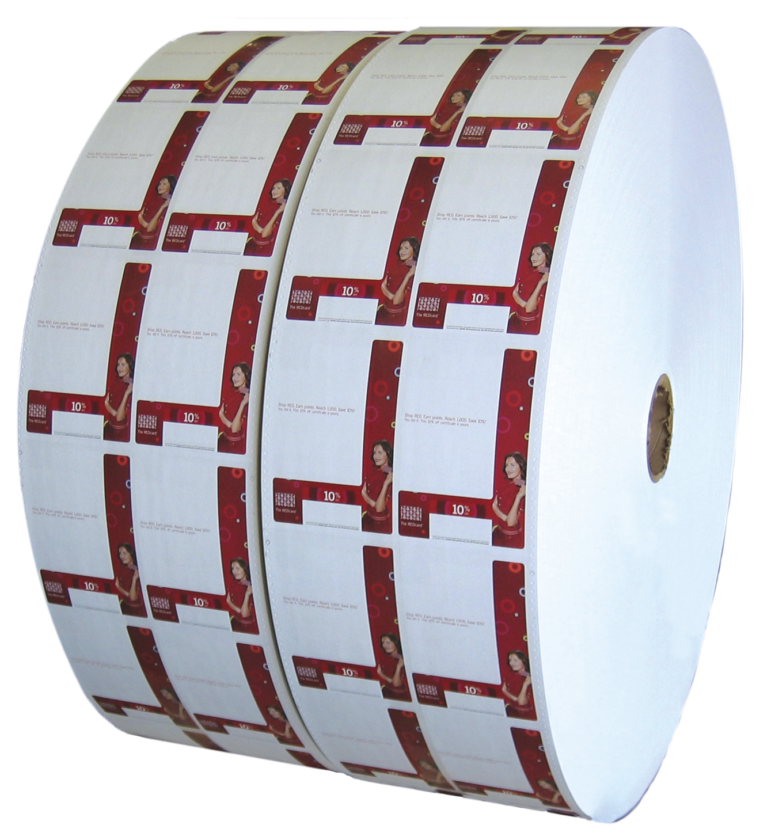
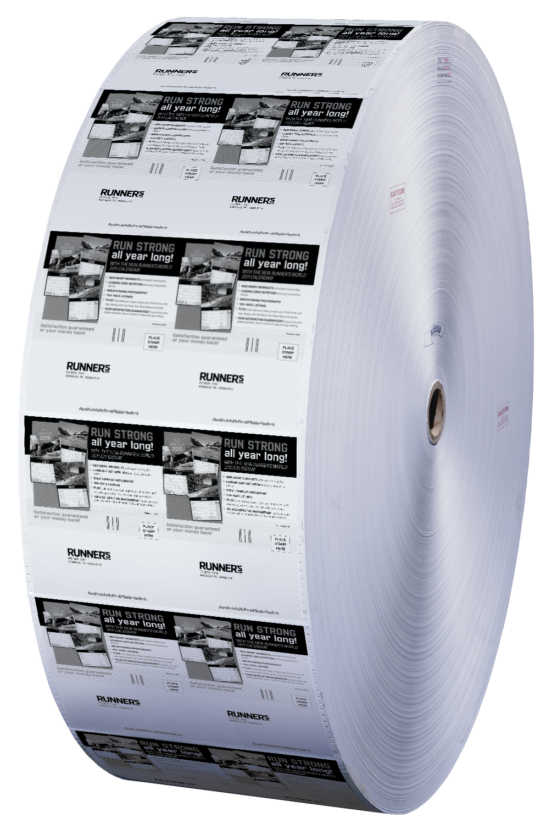
It’s all in the name. “The term ‘jumbo rolls’ refers to large rolls of paper – typically 50 inches in diameter with an 18-inch width – that are imprinted through high-speed inkjet printers,” says Bob Saunders, vice president of sales for Wise. “This configuration produces two-across, 8.5-inch by 11-inch or 14-inch images.”
Saunders breaks the jumbo roll market into three categories based on their print features.
The first is a pre-printed jumbo roll that has static content like logos and text. These are stock designs that are then overprinted with personalized information, like a recipient’s name, and sold by distributors or direct-to-consumer print brokers.
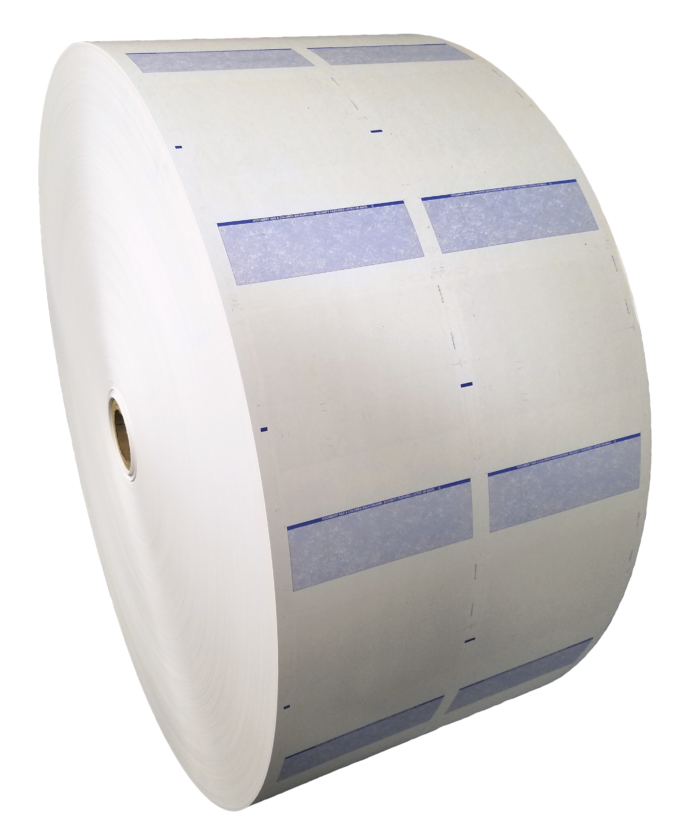
The second market is blank jumbo rolls with certain value-add features like perforations or pre-punched holes, which are also sold by distributors or direct-selling printers.
Finally, there are the folks in the print space that sell the reams of paper directly to printers. This aspect of the marketplace isn’t as relevant to distributors.
That’s because, simply put, jumbo roll printing takes up a lot of material and requires large equipment. It’s not something that a printer in a small space, or even more so a promo distributor who might have grown into decoration with a direct-to-film printer in a garage space, would buy.
“Jumbo roll printing presents a significant barrier to entry,” Saunders says. “It requires a full-sized press, plus specialized unwinding and rewinding systems, climate-controlled storage, material handling equipment and substantial floor space. The economics only work at scale, demanding high-volume orders from large corporations, major insurers and utilities processing millions of statements monthly under multi-year contracts, commitments you’d want secured before making a multimillion-capital investment.”
However, this only applies if you’re investing in the equipment to print things yourself. Saunders is quick to point out that these types of orders are a great opportunity for printers – they just require partnering with an established printer to do the heavy lifting.
“For small printers entering the jumbo roll market, reselling makes the most sense,” he says. “Partnering with established specialists is the strategic choice.”
Continuous Demand
As Saunders points out, jumbo roll printing is best suited for customers who need print products at a steady rate. These can be things like invoices, business forms or direct mail pieces that are distributed year-round and on a large scale.
“We do a lot of statement work for insurance companies,” says Doug Maracek, director of sales and marketing at Integrated Print & Graphics in South Elgin, IL, which is affiliated with Ennis (asi/52493), a Print & Promo Marketing Top Print Supplier. “Anybody that’s doing large volumes of invoicing does a lot of jumbo roll production. It’s really geared toward that larger-volume product for either statements or solicitations. Many big bank partners will run them and then mail out to the masses – all of their client letters and things like that.”
Maracek says that for smaller one-off jobs, printers would be more likely to use digital equipment and cut-sheets. But, Maracek says that runs can number by the millions of pieces.
“I’m currently running a job on the press that’s 100,000 pieces on a roll,” he says. “We run stuff that’s 2 million, 5 million, 20 million and the full gamut in between.”
And, rather than some print or promo orders that tend to come in at a certain time of year (with quiet periods in between), the print products produced by jumbo roll printing are continually used.
“This is a consumable product,” Maracek says. “You’re running it on a quarterly, biquarterly, bimonthly basis. You’re not running it once a year. It’s ongoing.”
Steven Osterloh, vice president of sales and marketing for Ennis, adds that they call jumbo roll print sales “mailbox money” because of its steady, recurring nature.
In addition to finance, Saunders says that some of the most reliable customer verticals for jumbo roll print include government agencies, large retailers, healthcare organizations and utilities companies. These can include direct mail pieces advertising a sale or bills from an electric company.
“The typical client handles consolidated billing and shares common characteristics,” Saunders says. “Regulatory requirements for paper documentation, customer bases numbering in the hundreds of thousands or millions, and regular billing cycles that create predictable volume.”
Room for Creativity & Innovation
The nature of jumbo roll printing hasn’t changed drastically over the years, even as other tech innovations related to print and the job of a distributor have fundamentally rocked the status quo. On the print side, Saunders says that the evolution of inkjet printing has allowed for more speed, but that hasn’t trickled down to distributors and resellers so much.
Perhaps the largest “development” in tech as it pertains to the print distributor selling jumbo roll printed products is the development of data usage. Using variable data to create a personalized piece takes the item from mass-produced junk mail to a much more intriguing place.
“The data mining that’s happening where they’re really digging down and getting very specific and making the offers count to you as a person – it’s not generic anymore,” Maracek says. “It’s so much more tailored and personal.”
He recalls one specific job that Ennis did for Marriott Hotels, where they took data from guests who they knew had used the health club, and made the marketing piece focus on new health club renovations at their facility. The same goes for guests who visited the restaurant in the hotel, where an item would be specifically printed to appeal to that person.
“I think that’s a big part of the innovation on the marketing side,” he says. “The data mining and getting it narrowed down to what would pique your interest and get you to open the offer and follow through on the offer’s next step.”
And just because an item is mass printed doesn’t mean that it’s a simple, boring white sheet of paper. There are aspects of the print piece to take into account just as there would be on any print or promo campaign, like the paper stock and material to maximize the look and feel the piece should convey, or certain finishing techniques like metallic ink for a more luxurious and upscale look.
“I think there’s a lot of value-add to the traditional jumbo roll,” Maracek says. He points to perforated punch-out membership cards on a form as an example.
“It’ll go out and get an integrated card, or we can produce somewhere they have a perforated card, integrated right into the form,” he says. “So now when it goes out, you have a card at the bottom that you can pop up and it’s your membership card, or it’s a coupon you can use.”
Maracek also mentions the use of QR codes, which have been around for a while but really exploded in widespread use and understanding during the COVID years when people had to scan codes for reading menus or accessing web pages.
“A lot of people are now printing with the QR codes that will take you to the landing page,” he says, “which will then keep you in the cycle of their marketing campaigns.”
Becoming Vital
The beauty of jumbo roll print (and this is notable for promotional products distributors) is that it has the potential to make the distributor a necessary part of their customer’s business. Since the forms and similar products must arrive steadily, customers aren’t likely to grind the process to a halt if they don’t have to.
“The key advantage lies in becoming difficult to displace when providing multiple critical services, including promotional products,” Saunders says. “You capture both print and promotional budgets, for example, while offering clients simplified vendor management and superior campaign coordination.”
He reiterates that jumbo rolls can be appealing for their order size, but that they should usually be left to the larger printers who can handle the literal weight of the job, leaving the rest of the process to the distributor or reseller.
“Don’t attempt to become a jumbo roll printer yourself,” Saunders says. “Partner with specialists for production while focusing on what you do best: building client relationships, developing creative campaigns and leveraging your promotional product expertise.”