
Key Takeaways
• Understanding basic printing terminology and processes helps distributors communicate more effectively with print service providers and deliver better client outcomes.
• The printing industry spans a wide range of methods and technologies – from digital and offset to direct-to-film and hybrid printing – each suited for different applications.
• Mastering the full workflow, including prepress, production and postpress, is key to successfully managing print projects and maximizing efficiency.
Working in a technical industry such as the printing space can be both exciting and a bit daunting. Distributors who educate themselves on the basic practices and terminology will find better success when curating projects for their clients.
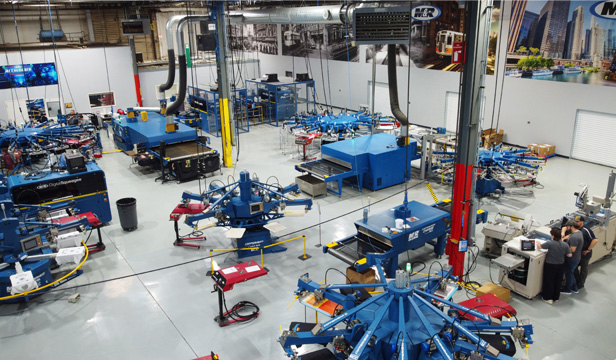
From common jargon to deep-dive equipment and process terms, this print primer can serve as a guideline for distributors looking to understand and work within the printing industry.
Must-Know Printing Terms
Calender press, calendering: (1) A finishing process that flattens one or both sides of a screen mesh reducing mesh thickness and opening size; (2) A way of manufacturing plastic sheets by first converting the resins into a doughlike mass, then passing it between heated pressure rollers to form a sheet with a glossy or textured surface; (3) A method of producing a very high-gloss surface on paper stock by passing the sheet between a series of pressure rollers; (4) A finishing process for fabric creating high luster, glazing, embossing and moiré.
Color separation: (1) Separating the areas of a piece to be printed into component spot and process ink colors; (2) A process using red, green and blue filters to divide the colors of a multicolored original into the process colors of cyan, magenta, yellow and black; (3) A photographic technique involving photographing original continuous-tone colored art through a series of filters, each to provide negatives representing the colors used in rendering the original.
Continuous-feed/Web-fed/Roll-fed: A printing press or converting machine that receives substrate as a continuous web.
Cut and sew: A garment production method in which fabric is first dyed, printed or otherwise finished in flat yardage and then cut into pattern pieces and sewn together to create the final apparel item. In textile dyeing or apparel decoration contexts, it distinguishes garments that are decorated before assembly rather than printed or dyed after the garment is already constructed.
Debossed: A technique for impressing a design or texture into a material.
Die cut/Die cutting: The process of blanking or cutting a sheet or roll stock to a predetermined shape.
Digital front end (DFE): Software and processing system that prepares and manages digital print files before they are sent to a printer. The DFE controls tasks such as color management, job processing, raster image processing (RIPing) and workflow automation to ensure accurate and efficient production.
Digitizing: To transform a continuous-tone image into computer readable data using a scanner. Used in the embroidery process.
Direct to film: A digital design is printed onto a special film, coated with adhesive powder and then heat-transferred onto fabric.
Direct to object: Digital printing process in which images or graphics are printed directly onto three-dimensional items, rather than onto flat media.
Embossed: A technique for impressing a design or texture into a sheet of material from the back of the sheet so that the design, though remaining an integral part of the sheet, extends forward toward the viewer.
Halftones: Patterns of small dots that vary in size, spacing or density to simulate continuous-tone images such as photographs in printing. Halftoning is fundamental to screen, offset, flexographic and digital printing processes across apparel, commercial, packaging and publication printing.
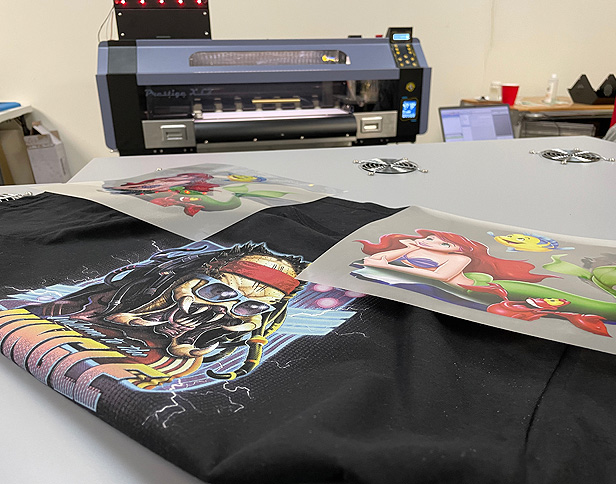
Hybrid printing (apparel): A production approach that combines traditional analog printing methods, such as screen printing, with digital printing technologies in a single workflow or press configuration.
Inkjet: A printing technology that propels microscopic droplets of ink onto a substrate to form images or text.
Make ready: The procedures necessary to properly adjust production equipment to perform a print or finishing operation; the act of making ready or setting up to print.
Offset: (1) An indirect printing form; (2) The unintentional transfer of ink to the bottom of the printing screen, the back of a succeeding sheet or other undesired surface.
Plastisol: A dispersion of finely divided resin in a plasticizer or series of plasticizers, usually 100% solids with no volatiles. (If the mixture contains volatiles, it’s known as an organosol).
Postpress: Finishing and processing operations that occur after printing is completed.
Prepress: All preparatory operations performed before the actual printing operation.
Print on demand: A production model in which printed materials are produced only after an order is received, eliminating the need for large inventory.
Print service provider: Refers to a company that offers professional printing services and related solutions to customers, ranging from design and prepress to printing and finishing.
Printhead: Component of a digital printing system that precisely deposits ink or other fluids onto a substrate to create an image.
RIP software: Raster image processing is a process using mathematical algorithms to enlarge and print an image.
Sheet-fed/Cut-sheet: To mechanically pick up and place separate sheets of a substrate into a press at predetermined intervals.
UV-LED: A printing technology that uses ultraviolet light-emitting diodes to instantly cure specially formulated inks as they’re printed.
Web to print: An online system that allows customers to design, customize, order and submit print jobs through a web-based interface that connects directly to a printer’s production workflow.
Wide format: Printing technologies designed to produce large graphics that exceed standard commercial print sizes.
Learn More About Printing
For a complete glossary on printing terms and phrases, check out this glossary from ASI’s strategic content partner PRINTING United Alliance.