
Tariffs were the defining story of the promotional products industry in 2025 – and so far they’re been the story of 2026 as well.
By late last year and into early 2026, the day-to-day volatility that characterized much of 2025 – tariffs imposed and then rescinded, rates shifting with little notice – had eased into a relative status quo.
Then, on Feb. 20, the Supreme Court struck down the country-by-country “reciprocal” tariffs as well as the “trafficked” tariffs placed on China, Canada and Mexico. President Donald Trump responded by implementing a global tariff rate of 10% that would remain in effect for at least 150 days (while signaling a potential increase to 15%).
Once again, suppliers and distributors were thrust into uncertainty. Many promo companies that had already adjusted their supply chains must now reassess their next moves.
Even as the tariff landscape continues to evolve, government data and key trade metrics show that the flow of goods into the U.S. has already been significantly reshaped. Counselor analyzed the numbers to examine how customs revenue surged, imports from major promo sourcing hubs like China declined sharply and what the true effective tariff rate looks like. We also spoke with leading suppliers about how they responded – and how they’re navigating the latest developments.
Surge in Customs Revenue
In 2024, the U.S. government collected about $71.5 billion in customs revenue.
In 2025, that figure had been surpassed by June. Through the full year, the U.S. government collected more than $265 billion in tariffs and customs duties – 3.7 times the 2024 total.
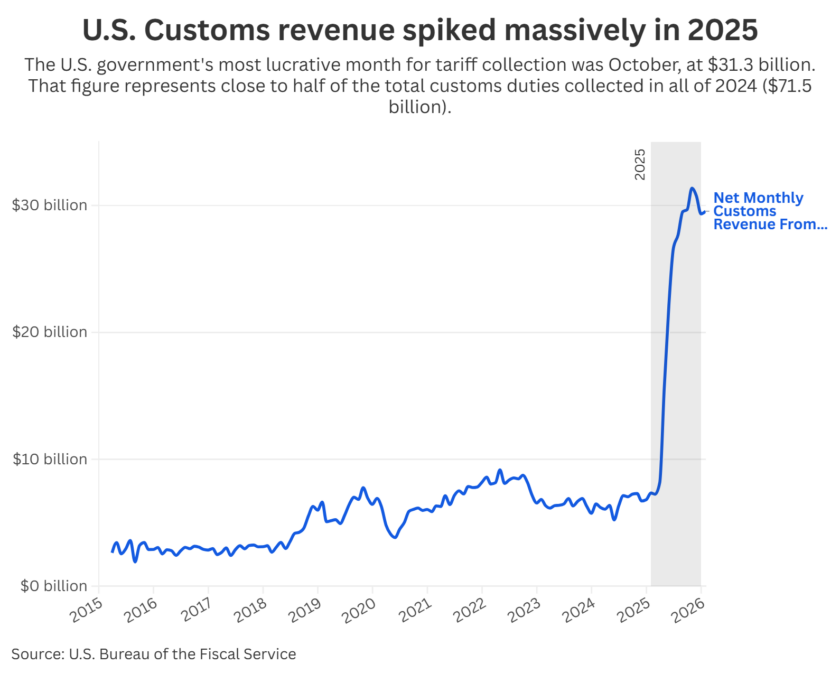
Specifically, customs collections went from $8.2 billion in March to $15.6 billion in April – an increase of 90%. Of course, that’s when President Donald Trump’s first intensive round of reciprocal tariffs went into effect and when the announced levy rate for imported Chinese goods peaked.
October recorded the highest revenue from import tariffs, totaling $31.4 billion. For comparison, prior to 2025, peak monthly revenue from tariffs was $9.6 billion in April 2022, when pandemic restrictions (and their subsequent supply chain woes) began to ease. Although monthly revenue has dipped slightly since November, figures have settled at a rate that’s still more than triple the approximate monthly averages for 2024.
The promo industry particularly felt the economic repercussions of heightened tariffs – and more often, the ambiguity that came with changing rates – during a rocky start to 2025 that, according to ASI Research, saw North American distributor sales decline in the first half of the year, with nearly half of distributors reporting year-over-year declining sales in Q2 ’25.
Many promo companies rebounded with sales growth in the second half of the year, but the concrete impacts on operational costs for the year were clear.
Dilip Bhavnani, COO of Counselor Top 40 supplier Sunscope (asi/90075), for example, estimates that his firm paid several million dollars in tariffs for 2025 – easily triple what they might have in 2023. At tech-focused supplier iClick (asi/62124), CEO Jeff Roberts says the company spent 44% more on tariffs in 2025 than they did in 2024, despite moving slightly less overall inventory.
Eric Turney – president of distributor The Monterey Company (asi/275832), which manages a significant chunk of custom overseas orders – approximated that roughly 50% of an item’s cost was going toward a tariff charge, compared to maybe 15% previously.
Tariff rates differ by country of origin and product category due to duty-free rules and trade agreements, resulting in varied charges for promo firms based on their sourcing and product choices. One thing was clear: Costs rose sharply.
Tariff Rate Spikes & Promo Price Increases
North American promo distributors recorded $27.7 billion last year – an increase of 4.2% from 2024. Although the reported number set a new industry record, much of the growth resulted from price increases implemented by both suppliers and distributors in response to tariffs, rather than from increased sales volume.
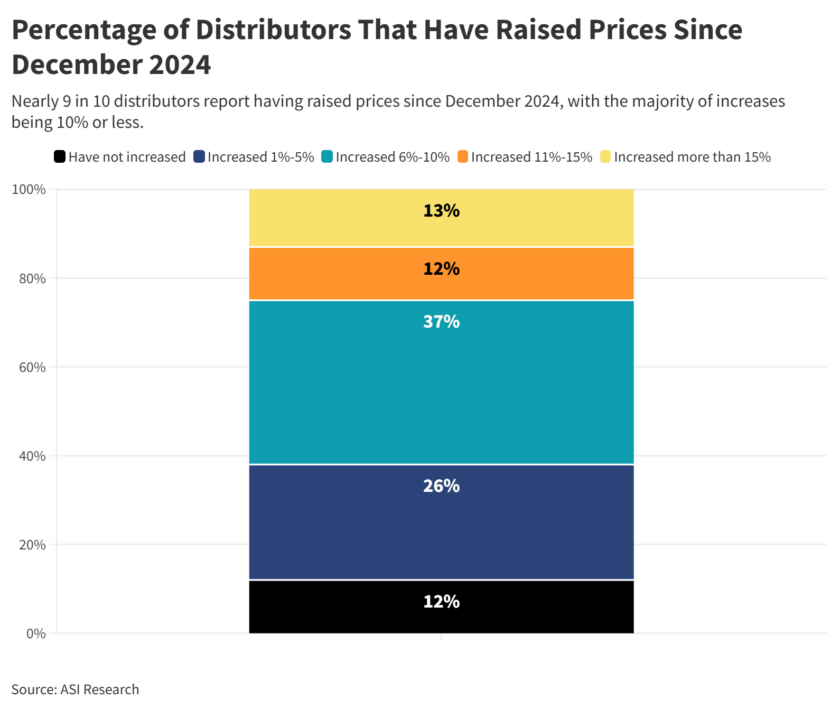
ASI Research found that nearly 90% of distributors had raised their prices throughout the year to an average of 11% – well over the industry’s growth rate. When last asked by ASI Research in June, two-thirds of suppliers had also raised prices. In conversations this year, suppliers told Counselor that, at a certain point, price increases became inevitable due to the direct impact tariffs had on operational costs.
Economists have estimated that the overall average effective tariff rate – which is calculated by factoring in different countries’ levy rates, product category exceptions and trade agreements – spiked as high as 17% in April when the highest tariffs on China (which reached as high as 145%) were in effect.
It had settled at around 13%, according to a recent report from the Federal Reserve Bank of New York, prior to the Supreme Court announcement. Now, estimates suggest that the average effective rate is about 12.2%, factoring in a temporary global 10% rate put in place shortly after the Supreme Court ruling, and heightened steel and aluminum tariffs that remain in place. If the global tariffs aren’t extended by Congress after 150 days, the effective rate is estimated to fall to about 9%.
While a marked decrease from its highest rate, it’s still a significant jump from an average of just 2.6% at the beginning of 2025.
Sunscope’s Bhavnani tried to be as open as possible with clients about line-item costs like shipping and tariffs over the course of the year, particularly when deciding in which country to manufacture a custom order. On a more granular level, that has meant negotiating with his factory partners overseas more frequently to win savings on cost of goods. (Tariffs are paid based on the price that the importer pays for the product, rather than the final price a consumer pays for an item once it’s in the United States.)
“We’re more actively involved in day-to-day operations overseas than we’ve ever been,” Bhavnani says, “just to be able to find those savings and pass them along to clients.”
This type of negotiation is common to help keep U.S. importers interested in working with certain factories, but the NY Federal Reserve Bank Report also showed that, on average, foreign exporters reduced initial purchase prices by less than 2%. Considering that distributors raised prices by an average of 11%, it appears that promo end-buyers – and very likely retail consumers – are ultimately paying for tariff-driven price increases.
The Monterey Company, Turney says, was focused on optimizing operations through automation to reduce costs where they could – but still had to increase prices a fair amount for customers as a pass-through on the tariff costs. Counselor Top 40 supplier Edwards Garment (asi/51752) had to raise prices roughly two or three times as much as they typically would in a given year, estimates CEO Jose Gomez.
“We don’t source a lot from China,” says Gomez, a member of Counselor’s Power 50 list of the most influential people in promo. “But that’s where we ended up paying the most in tariffs.”
Sharp Drop in Chinese Imports
Some suppliers – including iClick, for example – have been able to bring some prices back down after the initial volley of extremely high tariffs. The company’s main goal, Roberts says, was to be able to return certain popular products to their “under $5” or “under $10” price points without tying up too much cash in extensive inventory. With the China tariff rate dropping even further – from 20% to 10% with the new global tariffs that are in place – it’s possible more suppliers with heavy Chinese presences could do the same, though widespread price reductions are considered unlikely.
One solution to lower prices, Roberts says, has been keeping already manufactured product at factories in China so it’s ready to go but not shipped out immediately upon completion. It was a way to make sure inventory was prepared without tying too much capital up in inventory – and tariff – costs before product was needed, Roberts says.
iClick is still largely dependent on China-manufactured goods, Roberts says, but the company has started to dip its toe into other countries and regions for sourcing, namely Vietnam and Europe.
That’s due to tariffs, of course, but it’s also indicative of a larger industry trend of promo companies exploring options beyond China for supply chain and sourcing management. Counselor’s 2025 State of the Industry Report found, for example, that 30% of suppliers strongly agreed with the statement that they were “actively exploring new countries for product sourcing due to uncertainty about the trade situation with China.” It was the highest percentage in the past five years – including during the pandemic and resulting supply chain crisis in 2020 and 2021.
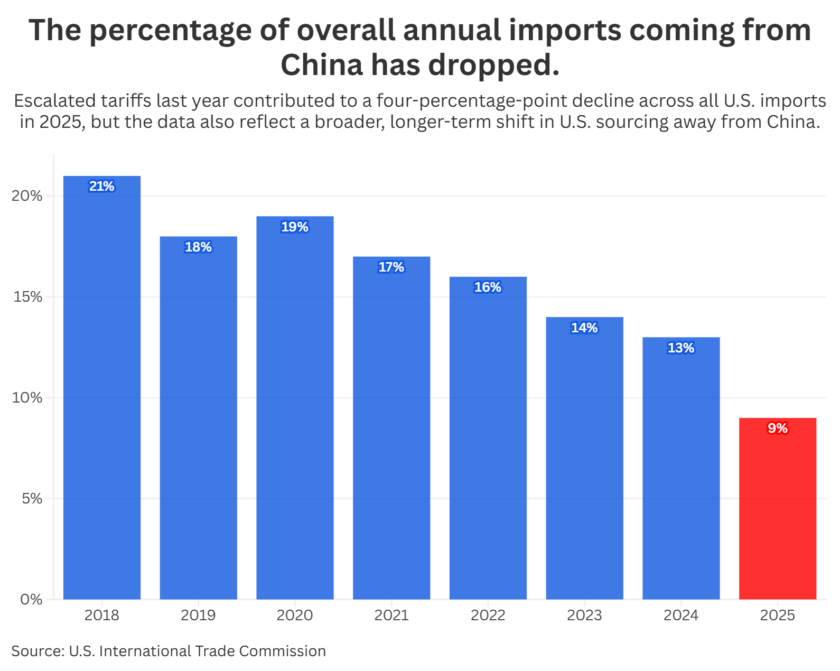
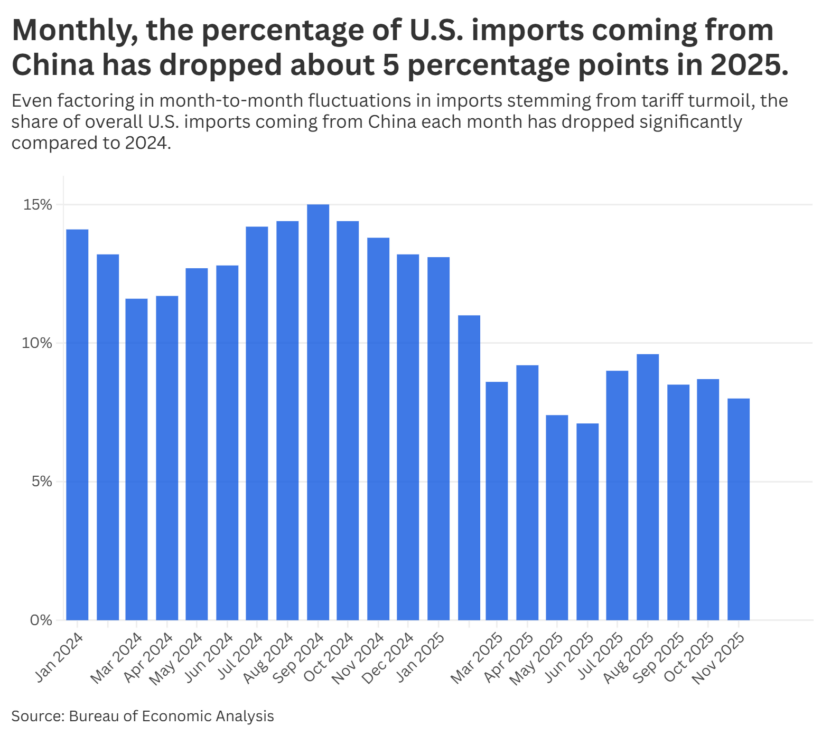
U.S. overall import data corroborates the shift happening in promo. Monthly Chinese imports hit their 2025 peak in January at $41 billion, which was comparable to several months in 2024. By the end of the year, however, the import rate was roughly half that, at about $21 billion for December.
Tellingly, the decline in U.S. imports from China isn’t merely reflective of reduced overall imports. In 2024, the average monthly share of imports from China was about 13%. Excluding the first few months of the year before the initial tariff announcement, in 2025, that figure fell to about 8.5%. Those monthly numbers are similar to the annual percentage of imports from China in 2024 and 2025 – and continue a downward trend since the pandemic.
The Monterey Company shifted some custom production from China to a factory in Bangladesh it had worked with during the pandemic, particularly in the spring and summer when China’s tariffs were at their height – though it faced issues with the factory being able to meet demand and production times.
“We definitely weren’t the only supplier that went over to them,” Turney says. “They got hit with a ton of orders and couldn’t keep up with volume.”
Bangladesh has also become a staple for Sunscope, which has spent the past five years diversifying a significant portion of its business away from China. Before, Bhavnani estimates, nearly all of his product came from China. Now, it’s only about 40% – and that’s largely rush orders needed quicker than how fast shipments from India, where he also runs a large operation, or Bangladesh can make it to the U.S.
The back-and-forth on individual country rates, though, made it tough to plan and quote orders, Bhavnani says, particularly given how far out his production cycle was. Flexibility became crucial. When the Trump administration slapped India with a 50% tariff in August, for example, Sunscope began trucking supplies between India and Bangladesh, which had a lower tariff rate. (There was also a corresponding drop in August imports from the Southeast Asian nation, according to U.S. trade data.) Bangladesh’s tariff rate dropped even further, from 19% to 10%, following the Supreme Court ruling.
“We like to plan six months out, and my guys are being told ‘You don’t have that ability,’” Bhavnani says. “We have to be able to move.”
India’s 50% tariff was brought down to 18% in February before the Supreme Court ruling, and Bhavnani immediately began shifting some production back when he heard the news, he says. This was before India’s rate came down to 10% after the ruling.
Monthly imports from Canada have decreased this year, though not nearly as substantially, following increased tariffs on lumber imports and public standoffs between the Canadian and U.S. governments over anti-tariff advertising. On the other hand, countries like Vietnam and Thailand, which promo pros have reported also sourcing product from, have recorded notable increases in imports so far in 2025. Their reciprocal tariff rates were 20% and 19% before the Supreme Court ruling, respectively – higher than they were at the start of the year, but on the low end of additional levies placed in 2025.
For Edwards Garment, there are certain fabrications that the company still relies on Chinese factories to manage, Gomez says, but the amount of product it produces there is as low as it feasibly could be. Tariffs were the final push the company needed to reallocate sourcing. Instead, it pursued more production in places like Mexico and Central America.
In recent years Mexico had been emerging as a popular nearshoring option both in the promo industry and for U.S. businesses in other industries. Imports from Mexico didn’t shift very much in value in 2025 compared to 2024 – but they were nearly double the dollar value of imports from China, notable considering that 2024 was the first time in two decades that Mexican imports surpassed Chinese ones.
Gomez says he’s noted significant interest in Mexican and Central American manufacturing, despite some limitations in the region for managing certain types of textiles or advances in fabric development. That sourcing focus proved a benefit for Edwards Garment in 2025, as tariffs on Central American companies were among the later levies to go into effect and remained around the 10% level. And many imports from Mexico are duty-free due to the U.S.-Mexico-Canada Agreement.
“It’s busy,” he says. “A lot of people are going into these factories and wanting to place production there even though the capacity is not as big – all of those countries together are probably not a tenth of what you can get out of China.”
U.S. Trade Deficit Barely Budges
The U.S. trade “balance” is calculated by subtracting the value of imports into the country from the value of American goods exported overseas — and it’s been negative since the 1970s. Since the U.S. began recovering from the 2008 recession, that trade imbalance has steadily widened.
Although last year’s trade shifts may suggest otherwise, that trend continued in 2025.
Despite several months of progress toward narrowing the deficit – including reaching its lowest level in more than a decade in October – the U.S. still imported nearly $1.25 trillion more in goods than it exported, up from just over $1.2 trillion in 2024.
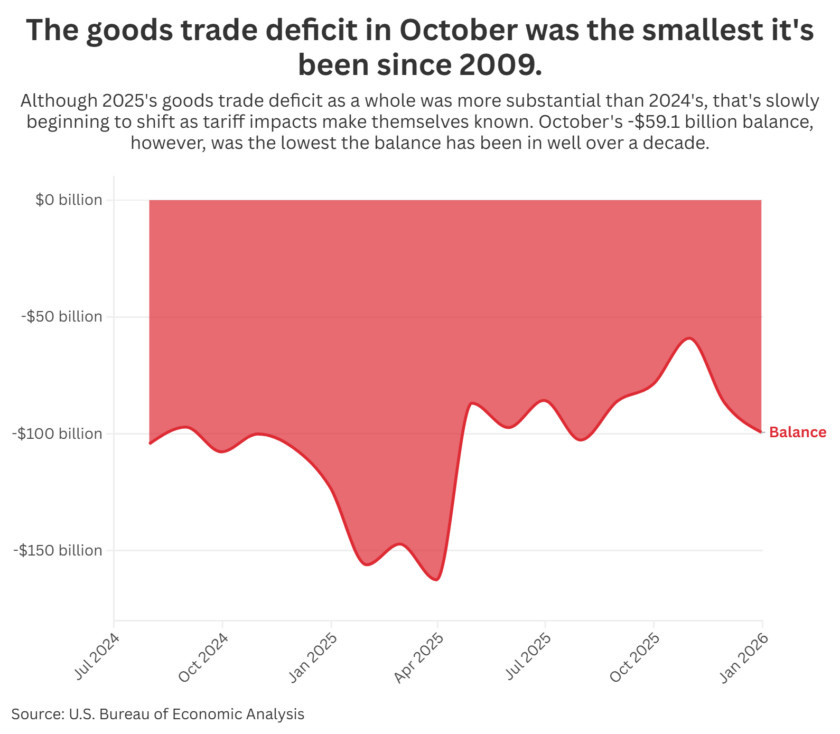
Trade experts have warned against drawing too many conclusions from the data. For one, goods imported spiked heavily in Q1 as U.S. businesses and retailers braced for potential tariffs to go into effect following Trump’s inauguration. Imports dropped back down in April, spiked again slightly in July ahead of another round of reciprocal tariffs, then fell after those tariffs went into effect, then rose again through the end of the year. November and December’s figures, in particular, were overall comparable to import levels throughout 2024.
The overall trade deficit did drop slightly – from $904 billion to $901 billion – when including both goods and services, where the U.S. tends to run a surplus. Both the modest overall drop and the goods-specific increase show that progress has been slow toward one of the administration’s stated goals of using tariffs to reduce the trade deficit and increase American manufacturing.
Promo pros told Counselor throughout last year that shifting promo’s overwhelmingly international supply chain to prioritize U.S. production would be neither simple nor fast. However, existing domestic promo manufacturers did note a limited level of increased interest in 2025.
Rich Carollo, president of Chicago-based supplier Lion Circle (asi/67620), felt there was a higher level of awareness around Made-in-USA goods throughout the year. There wasn’t necessarily an explosion in sales, but Carollo said he issued significantly more quotes than usual. He attributes that largely to clients who suddenly couldn’t get product due to tariffs or shipping issues – a similar pattern to the initial outbreak of the pandemic.
He also leaned into direct Made-in-USA marketing more for Lion Circle’s advertising and promotions, he says. Whereas sometimes in the past he’s felt that the “Made-in-USA” descriptor could be detrimental – because of its association with higher prices – this year, he felt it was more at the forefront of clients’ minds.
“It’s not blowing the doors off. You’re still not going to beat overseas – even with tariffs, they’re still going to be cheaper,” Carollo says. “But we’re definitely getting some renewed interest.”
The bigger draw, says Mitch Cahn of New Jersey-based hat and bag manufacturer Unionwear (asi/73775), has definitively been USA-made goods ahead of America250 celebrations in 2026, rather than increased interest due to tariffs alone. Unionwear, which primarily works with government clients, had a tougher 2025, thanks to government budget cuts in a variety of the federal agencies that Cahn services. But they’re off and running so far in 2026.
“We’re seeing our distributors come to us with big name-brand clients that we never thought would consider Made-in-USA products before,” Cahn says. “And it’s all because America250.”
What’s Next for Sourcing?
Suppliers had told Counselor that they weren’t taking drastic measures in response to the new tariffs. But they aren’t standing still either.
One important note is that the global 10% tariff has brought the rates down in key sourcing hubs, including China, where it was previously 20%. Roberts of iClick says that he sees the Supreme Court ruling as a positive because of just how much promo production is concentrated in China – but that it creates significant instability, particularly when it comes to planning for long-term or larger projects because of how much costs can shift day to day.
Turney says The Monterey Company isn’t planning to make any significant shifts as a result of the ruling, other than keeping in close contact with their logistics partners overseas. But he is keeping one foot in Bangladesh, where he can ramp up production if circumstances call for it.
Bhavnani agrees. Sunscope is considering pushing more production back toward China – but will also continue prioritizing India and Bangladesh.
“China provides everything we need,” Bhavnani says, “but with the political situation between the U.S. and China, we are extremely hesitant to focus production there.”
Read this full article on ASI Central.